
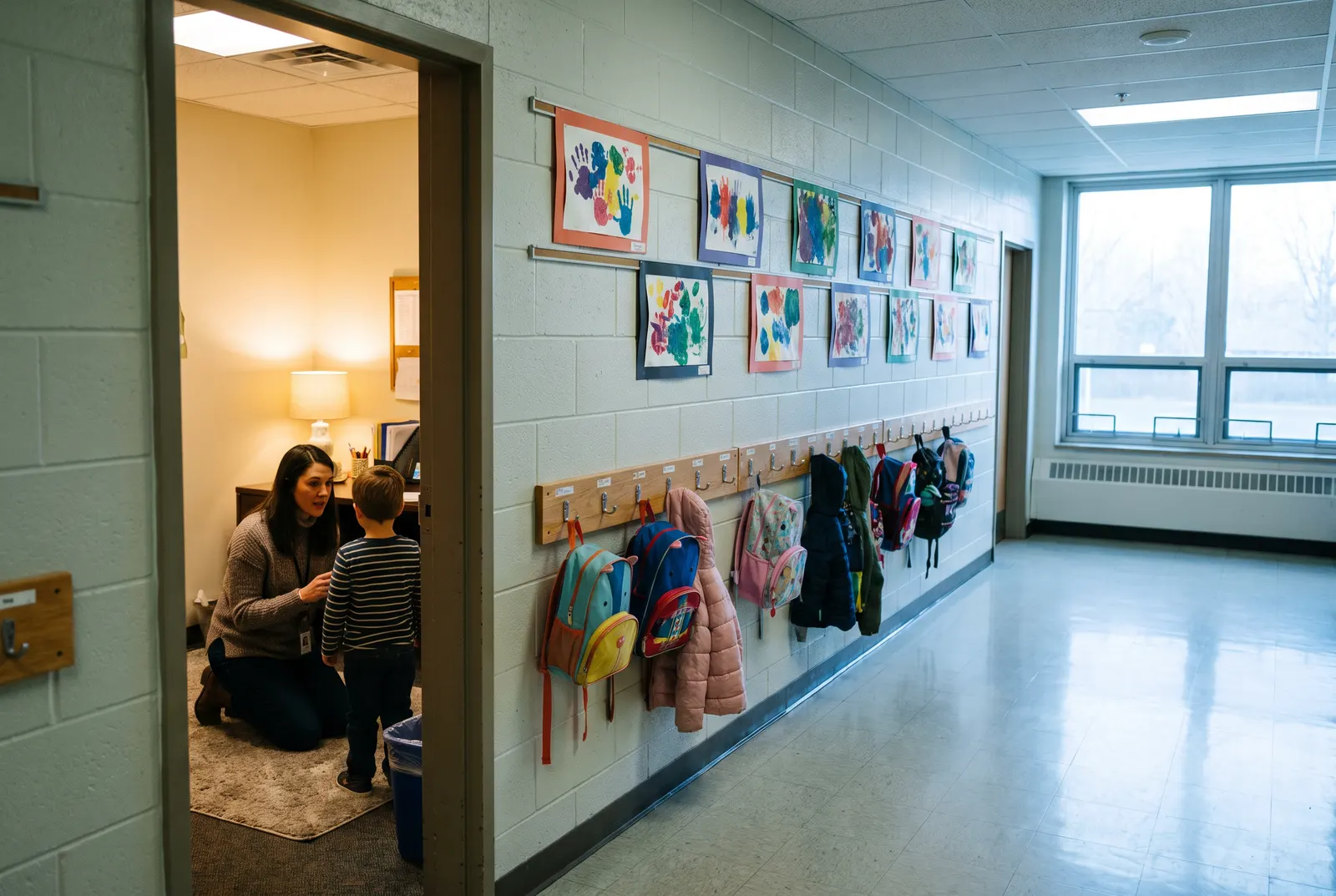
Clinical mental health counseling and school counseling are two tracks of the same counseling master’s, and they split on one question: who gives you permission to work. A CMHC degree leads to a license from your state counseling board, and only after two to three years of supervised clinical work. A school counseling degree leads to a certificate from your state education agency, which lets you work in a public K-12 school as soon as you graduate. If you’re searching for a school counseling master’s online, that difference matters more than the format. It decides your internship site, your first two years of work and how easily you can switch later.
Both tracks can be studied online, and eight programs in our directory run them side by side. Here’s how the coursework, hours, credentials and pay compare, and when a dual track makes sense.
How Do CMHC and School Counseling Master’s Programs Compare?
Start with the structure. The table sets the two tracks next to each other using CACREP, ASCA and BLS figures.
| Factor | Clinical mental health counseling | School counseling |
|---|---|---|
| Credential | State counseling license (LPC, LMHC, LCPC, LPCC or LCMHC) | State school counselor certificate or endorsement |
| Issued by | State counseling licensure board | State education agency |
| Entry-level degree floor (CACREP) | 60 semester or 90 quarter credits | 60 semester or 90 quarter credits |
| Graduate clinical hours (CACREP) | 700, including a 600-hour internship | 700, with practicum and internship in a K-12 school |
| Supervised work after graduation | 2,000 to 4,000 hours over 2 to 3 years | Generally none for the initial certificate |
| Exam | NCE or NCMHCE | A state or national test such as the Praxis |
| Federal wage code | SOC 21-1018 | SOC 21-1012 |
| May 2025 national median | $59,350 | $64,330 |
| Interstate route | Counseling Compact for fully licensed counselors | State-by-state certificate rules |
The credit floor surprises people. Under the 2024 CACREP Standards, every entry-level degree needs at least 60 semester credits, whichever specialty you pick. Older 48-credit school counseling programs are why many people still think of school counseling as the shorter degree. In a CACREP program it isn’t.
By the Numbers
- 57 Programs Ranked
- $740 Median Master's Cost per Credit
Source: School program pages, November 2026
What Coursework Differs Between the Two Tracks?
The first year looks almost the same. Both tracks take the CACREP core: counseling theories, ethics, human development, group work, assessment, multicultural counseling and career development. Then the specialty courses pull apart.
The CMHC side builds toward diagnosis and treatment. The CACREP 5-C standards cover the diagnosis and treatment of mental and behavioral disorders, intake interviews and mental status exams, treatment planning, and third-party reimbursement. In the directory, that looks like COAD 6418 Diagnosis and Psychopathology in Counseling at East Carolina University, COU 630 Diagnosis and Treatment of Mental Disorders at Bradley University, and COUN 7337 Clinical Diagnosis at Our Lady of the Lake University.
The school side builds toward running a counseling program inside a school. ASCA’s National Model frames that work around a schoolwide program that supports students’ academic progress, career plans and social and emotional growth, delivered through classroom lessons, small groups, individual planning and short-term counseling. You learn to work with teachers and families, to use school data and to coordinate referrals out to clinicians. You don’t learn to bill insurance, because school counselors don’t.
That’s the clearest test of fit. If the part of counseling that interests you is assessment and ongoing therapy with a client over months, the CMHC courses are the ones you want. If you’re drawn to prevention work, college planning and being the adult a hundred students know by name, the school courses are.
How Do the Internship Hours Differ?
On paper the hour counts match. CACREP requires a 100-hour practicum with 40 direct hours and a 600-hour internship with 240 direct hours. The difference is the setting. ASCA notes that school counselor credentials typically require practicum and internship in a K-12 school. CMHC students intern at outpatient clinics, community mental health centers and hospitals, or at a similar clinical site.
For online students, that has a practical upside on the school side. Every town has schools, and districts often have a routine process for hosting counseling interns, even though you still need a certified school counselor willing to supervise you. CMHC students in rural areas sometimes struggle more to find a site with a licensed clinical supervisor. Our practicum and internship guide goes into how to find and secure a site.
School internships run on the school calendar. You start when the school year starts and stop for winter break, which can stretch a 600-hour internship across two semesters with little flexibility. Clinical sites often run year round, so CMHC students can sometimes spread hours into summer.
A dual-track student completes both sets of field hours, which is a big part of why dual programs run long.
What Is the Difference Between a License and a State Certificate?
A license from the counseling board allows independent clinical practice, which means you can diagnose and treat mental health conditions and bill for that care. You get there in two stages. After graduation you hold an associate or provisional license and work under supervision for 2,000 to 4,000 hours, which takes two to three years in most states. Then you pass the required exam and apply for the full license. Our licensure titles guide explains how those names and steps vary by state.
A school counselor certificate comes from the state department of education. ASCA describes the typical requirements as documented school counseling coursework from an accredited institution, a K-12 practicum and internship, and a passing score on a state or national test such as the Praxis. Once you meet them, you’re credentialed. No post-master’s supervision period is required for the initial certificate in most states, which means a school counseling graduate earns a full salary sooner.
The two credentials don’t substitute for each other. A school certificate doesn’t let you open a private practice. A counseling license doesn’t, by itself, qualify you for a public school counselor position. Some states issue the school credential as a license rather than a certificate, but it’s still the education agency’s credential with the education agency’s rules.
Portability works differently too. Fully licensed counselors can use the Counseling Compact to practice across member states once their home state is live. School counselor certificates move state by state, under each education agency’s reciprocity rules.
Which Pays More, School Counseling or CMHC?
Nationally, school counselors come out ahead at the median. BLS May 2025 data puts the school and career counselor code (SOC 21-1012, which BLS titles educational, guidance and career counselors and advisors) at a $64,330 median and mental health counselors (SOC 21-1018) at $59,350. The school code also covers college advisors and career counselors, so it isn’t a pure K-12 figure. Our school counselor salary guide breaks down what that code measures and how district pay schedules work.
The national number hides how much the order changes by state:
| State | School and career counselors, median | Mental health counselors, median |
|---|---|---|
| California | $86,500 | $59,250 |
| New York | $71,610 | $59,450 |
| Texas | $67,900 | $62,630 |
| Virginia | $67,660 | $59,880 |
| Georgia | $63,720 | $58,960 |
| Illinois | $62,420 | $60,730 |
| Ohio | $61,760 | $58,360 |
| Pennsylvania | $60,880 | $52,010 |
| North Carolina | $57,630 | $55,490 |
| Florida | $53,140 | $56,790 |
California is the extreme case, with school counselors far ahead. Florida goes the other way. In most states on the table the school median is higher, but the size of the gap varies a lot.
The top of the range tells a different story. The 90th percentile is $104,770 for school and career counselors and $97,590 for mental health counselors nationally. But BLS wage data covers salaried workers only. Self-employed counselors in private practice aren’t in the OEWS figures, and private practice is where many licensed clinicians earn their highest income. School counselors don’t have that option without adding a clinical license.
Timing matters as well. A school counselor graduate starts at a full certified salary. A CMHC graduate starts as an associate, where pay often sits near the 25th percentile of $47,100, for the two to three years of supervised work. Over the first five years, that difference adds up, even in states where the clinical median is higher.
Which Online Programs Offer Both School Counseling and CMHC?
Eight programs in our directory run school counseling alongside CMHC, and they’re ranked on our school and CMHC dual-track programs list. Most deliver the coursework online. Here is how they compare on format and price for the CMHC degree we track.
| Program | Delivery | Rate | Campus requirement |
|---|---|---|---|
| Pennsylvania Western University | Fully online | $568 per credit ($557 in state) | None |
| Thomas University | Fully online, synchronous | $635 per credit | None |
| Colorado Christian University | Online with residencies | $698 per credit | Three in-person residencies in Colorado |
| University of Holy Cross | Fully online | $780 per credit | Two one-day Zoom residencies from fall 2026 |
| University of Mary | Weekly live classes online or in Bismarck | $695 per credit | Two COU 789 Institutes |
| Our Lady of the Lake University | Fully online | $1,031 per credit | None |
| East Carolina University | Online with residencies | $277.06 in state, $1,044.06 out of state | Two on-campus residencies from July 1, 2026 |
| Bradley University | Online with residencies | $1,158 per credit | Campus residencies |
A few details stand out. PennWest’s clinical mental health and school counseling tracks earned unified CACREP accreditation in June 2025. Our Lady of the Lake holds CACREP accreditation for its CMHC, clinical rehabilitation and school counseling specializations through October 31, 2034. Thomas caps core classes at a 1:12 faculty-to-student ratio. And East Carolina admits its CMHC and student affairs tracks for a fall 2027 start only, so check the school counseling track’s own intake schedule.
Online school counseling has one extra wrinkle. Your certificate is issued by your state’s education agency, which may want an in-state approved program or a specific test. An online program based in another state can still work, but ask the school for its written licensure disclosure for school counseling in your state, separately from the CMHC disclosure. The answers aren’t always the same.
Related Rankings
- School and CMHC Dual TrackMaster's programs combining clinical mental health counseling with school counseling pathways for K-12 and clinical licensure.
- Child and Adolescent CMHCClinical mental health counseling master's degrees offering child, adolescent, youth, or family-centered clinical concentrations.
- Best Online CMHC ProgramsOnline clinical mental health counseling master's programs ranked by real per-credit cost, CACREP accreditation, residencies, and outcomes.
- CACREP Online CMHC ProgramsOnline CACREP-accredited clinical mental health counseling master's programs ranked by tuition, residencies, practicum support, and outcomes.
What Does an Online School Counseling Program Look Like Week to Week?
It depends heavily on the school, and the differences are bigger than the brochures let on. Thomas University runs synchronous classes in 8-week terms with five starts a year, so you show up to live sessions but take fewer courses at a time. University of Holy Cross mixes live and recorded work across 16-week terms with three starts a year. University of Mary meets once a week, live, either on its Bismarck campus or by video. Our Lady of the Lake runs 14-week terms fully online.
Short terms suit people who want to focus on one or two courses at once. Long terms suit people who want a steadier weekly rhythm and fewer registration cycles. Neither one shortens the internship, which follows the school calendar anyway once you reach it.
Live sessions matter more in counseling than in most online degrees, because skills practice needs a partner and an observer. The 2024 CACREP Standards require live evaluation of your counseling skills before practicum in every delivery format. Expect some sessions at fixed times even in a program advertised as flexible, and ask for the time zone before you enroll. Our online vs. on-campus comparison goes further into residencies and schedules.
Working teachers often pick online school counseling because they can keep teaching through the coursework. The catch comes at internship. A K-12 internship happens during the school day, so a full-time teacher usually needs a leave, a reduced schedule or a district arrangement that lets them do counseling hours at their own school. Ask your district what it allows before you start the program, since that answer can set your graduation date.
Is a Dual-Track Master’s Worth the Extra Credits?
A dual track means both specialties’ coursework and both internships in one degree, so it takes longer. Colorado Christian University lists its dual master’s in CMHC and school counseling at 75 credits, against 60 for the CMHC degree alone at $698 per credit. That’s a full extra semester or more for most part-time students.
It pays off in two situations. The first is when you don’t yet know which setting you want. Students often discover during practicum that they prefer one population, and a dual track keeps both doors open without a second application. The second is a planned hybrid career: a school job during the year with evening or summer clinical work once you’re licensed. You’d need the clinical license for that, and the dual degree gives you the coursework the board wants.
It’s a poor fit when you already know. If you want to work in a school and nowhere else, a single school counseling track gets you to a full salary fastest. If you want clinical work, the CMHC track alone, plus electives with children and adolescents, covers most youth-focused jobs outside schools. Our child and adolescent counseling programs list covers those.
The license still requires clinical hours after graduation, even with a dual degree. A full-time school counselor can’t count school hours toward the 2,000 to 4,000 supervised clinical hours most boards require, so finishing a clinical license on the side takes longer than the usual two to three years. Price that in before you choose the dual track for the hybrid-career reason.
Military students should ask whether a school’s military rate covers both tracks’ courses, since some schools price the two departments separately.
Can You Switch Tracks After You Graduate?
You can, with extra coursework, and the direction matters. Going from CMHC to school counseling usually means a post-master’s certificate that adds the school-specific courses and a K-12 internship. Since a CMHC degree already meets the 60-credit floor, you’re adding the school pieces only.
Going from school counseling to a clinical license is often harder. Counseling boards look for clinical coursework such as psychopathology and treatment planning, and many want 60 credits. A school counseling degree from an older 48-credit program can fall short on both counts, which means extra graduate credits before the board approves your associate license. A 60-credit CACREP school counseling degree narrows that gap, but you’ll still need clinical supervision hours after graduation.
So if there’s a real chance you’ll want clinical practice someday, CMHC or a dual track is the safer starting point. The reverse switch costs less.
How Do You Choose Between CMHC and School Counseling?
Think about the work you want to be doing in year five. A school counselor in year five might run the counseling program for a middle school, teach classroom lessons and handle crisis response, on a school calendar with summers mostly off. Our school counselor career guide describes that day in detail, including caseloads, which ASCA reports averaged 372 students per counselor nationally in 2024 to 2025 against its recommended 250. A licensed clinician in year five might carry a caseload of adults or teens in therapy, bill insurance and supervise associates, year round, possibly in private practice.
Then check the practical points against your situation. Look up the two medians for your state. Ask your state education agency what it requires for a school counselor certificate, and your counseling board what it requires for an associate license. If both look right, a dual track is worth pricing.
For the rest of the program search, our CMHC vs. MSW guide covers the other common comparison, and how to choose a CMHC program covers accreditation and cost checks that apply to every track. To see the eight programs that offer both specialties in one department, go to the school and CMHC dual-track programs ranking.
Frequently Asked Questions
Can I Get a School Counseling Master's Online?
Can a School Counselor Become a Licensed Professional Counselor?
Can a CMHC Graduate Work as a School Counselor?
Which Pays More, School Counseling or Clinical Mental Health Counseling?
Is a Dual School and CMHC Master's Worth the Extra Credits?
Do I Need a Teaching License to Be a School Counselor?
Keep Reading
 School CounselorA school counselor needs a master's degree and a state school credential. See the K-12 duties, certification steps and how the job differs from CMHC work.
 School Counselor SalarySchool and career counselors earn a $64,330 national median in May 2025 BLS data. Compare 10-month school schedules against 12-month LPC pay.
 CMHC vs. MSW (LPC vs. LCSW)A CMHC master's trains you for clinical therapy while an MSW covers clinical work and macro systems. Compare exams, job settings, and wages.
 How to Choose a CMHC ProgramYou can compare CMHC master's programs on CACREP status, real per-credit tuition, campus travel, and state licensure rules before applying.
Sources
8 references
- State Requirements and Programs
- ASCA National Model for School Counseling Programs
- Student-to-School-Counselor Ratio 2024-2025
- 2024 CACREP Standards, Section 1 (The Learning Environment)
- 2024 CACREP Standards, Section 5-C (Clinical Mental Health Counseling)
- 2024 CACREP Standards, Section 4 (Professional Practice)
- Occupational Employment and Wage Statistics (May 2025)
- Counseling Compact FAQ
All sources retrieved .