

In an LMHC vs. LPC vs. LCPC vs. LPCC comparison, every acronym names the same independent profession: a master’s-trained clinical mental health counselor licensed to diagnose mental disorders and deliver psychotherapy while billing health insurance independently. State legislatures passed counseling licensure statutes on separate timelines over several decades and picked five different titles for the same core clinical scope.
That naming patchwork trips up graduate applicants and hiring managers alike. If you’re choosing a degree or planning to move across state lines later, you don’t need a separate master’s degree for each title. What you do need to check are the state-specific coursework mandates plus the exam and supervision rules tied to the board where you intend to practice.
Which States Use LPC, LMHC, LCPC, LPCC, and LCMHC?
Five primary independent license titles cover U.S. clinical mental health counselors. Check which title governs your home state and any state where you expect to see telehealth clients.
| Acronym | Full License Title | Example States Using This Title |
|---|---|---|
| LPC | Licensed Professional Counselor | Texas, Virginia, Colorado, Georgia, Pennsylvania, Michigan, Missouri |
| LMHC | Licensed Mental Health Counselor | Florida, New York, Massachusetts, Washington, Indiana, Iowa |
| LCPC | Licensed Clinical Professional Counselor | Illinois, Maryland, Maine, Kansas, Montana, Nevada |
| LPCC | Licensed Professional Clinical Counselor | California, Ohio, Minnesota, Kentucky, New Mexico, North Dakota |
| LCMHC | Licensed Clinical Mental Health Counselor | North Carolina, New Hampshire, Vermont, Utah |
A few states also keep an older two-level naming quirk where “LPC” sits at the provisional tier and “LCPC” or “LPCC” marks the independent clinical tier. In Ohio and Kentucky, for example, you start as an LPC or LPCA while accruing supervised hours and advance to LPCC once your board approves independent clinical status. Always verify whether “LPC” in your target state means independent practice or supervised associate status.
By the Numbers
- 57 Programs Ranked
- $740 Median Master's Cost per Credit
Source: School program pages, November 2026
How Does the Two-Tier Counseling Licensure Ladder Work?
Nearly every state divides licensure into two distinct stages after you finish your 60-semester-hour (or 90-quarter-hour) master’s degree and 700 graduate clinical hours.
Tier 1: Provisional or associate licensure. Right after graduation, you send official transcripts to your state board and clear background checks alongside any required entry exam. Your board then issues an associate credential such as LPC-A, LPCC-A, LMHC-Intern, or LCMHCA. That license lets you earn a paycheck seeing real clients at a clinic or group practice while an approved clinical supervisor reviews your caseload weekly.
Tier 2: Unrestricted independent licensure. Once you finish post-master’s supervised clinical experience and pass any remaining clinical or state law exams, your state board issues your full LPC, LMHC, LCPC, LPCC, or LCMHC license. From that point forward you can diagnose and treat independently, join commercial insurance and TRICARE panels, supervise newer associates after meeting state tenure rules, and open a solo private practice.
Post-master’s supervision requirements generally span 2,000 to 4,000 total clinical hours across two to three years. A widely used national benchmark, shared by many state boards and TRICARE’s independent provider rules, is 3,000 total post-master’s clinical hours (often around 2,000 direct client hours) paired with at least 100 hours of face-to-face clinical supervision over at least two years.
State-Specific Rules That Matter More Than the Acronym
Focusing only on the four letters after your name hides the actual licensure traps. State boards diverge sharply on mandatory CACREP accreditation and niche elective courses as well as state law exams.
Look at how seven major states differ on paper right now:
-
California (LPCC). California requires dedicated California law and ethics instruction plus suicide-prevention coursework beyond a generic 60-credit counseling curriculum. Out-of-state graduates often take post-graduation bridge courses if their school didn’t embed California Board of Behavioral Sciences modules. Browse in-state options on our California CMHC programs page.
-
Florida (LMHC). Florida expects dedicated graduate coursework in human sexuality and substance abuse alongside a CACREP or equivalent 60-credit counseling master’s. See local schools on our Florida CMHC programs page.
-
New York (LMHC). New York requires either a New York State Education Department (NYSED) licensure-qualifying registered program (such as University at Buffalo or New York University) or an individual coursework audit, followed by 3,000 supervised hours. Explore state options on our New York CMHC programs page.
-
Texas (LPC). The Texas Behavioral Health Executive Council (BHEC) mandates a 60-credit graduate degree plus a passing score on the NCE or NCMHCE, the Texas Jurisprudence Exam, and 3,000 supervised hours. Check Texas CMHC programs for in-state schools.
-
North Carolina (LCMHC). North Carolina requires a 60-semester-hour CACREP-accredited degree for new applicants. Review North Carolina CMHC programs before choosing an out-of-state school.
-
Ohio (LPCC). Ohio mandates CACREP accreditation for most new LPC and LPCC applicants and is already live inside the Counseling Compact. View Ohio CMHC programs for approved tracks.
-
Kentucky (LPCC). Kentucky requires a 60-credit degree and accepts CACREP-accredited programs directly toward LPCA and LPCC licensure without extra transcript hurdles.
If you expect to move during your career, graduating from a CACREP-accredited CMHC program is the simplest safeguard against transcript deficiency letters. CACREP status also keeps you eligible for VA Licensed Professional Mental Health Counselor (LPMHC) jobs and Military OneSource contracts.
NCE vs. NCMHCE: Which Licensing Exam Do You Take?
Regardless of whether your state calls you an LMHC or an LPC, your national exam comes from the National Board for Certified Counselors (NBCC). State boards pick the NCE, the NCMHCE, or both.
| Exam Feature | National Counselor Examination (NCE) | National Clinical Mental Health Counseling Examination (NCMHCE) |
|---|---|---|
| Primary assessment focus | General counseling knowledge, human development, theory, and ethics | Applied clinical judgment, intake, diagnosis, and treatment planning |
| Question format | 200 multiple-choice items (160 scored and 40 unscored pretest items) | 10 clinical case studies with 9 to 15 questions per case (130 to 150 total items) |
| Time limit | 4 hours and 15 minutes | 3 hours and 45 minutes (with optional 15-minute scheduled break) |
| Test delivery | Pearson VUE test centers or online proctoring where state board allows | Pearson VUE test centers |
| Linked NBCC certification | One of two exam options for NCC | Required exam for CCMHC and one of two options for NCC |
The two tests demand completely different study habits. The NCE rewards steady recall across eight core graduate subjects. The NCMHCE drops you into ten unfolding clinical cases where you select assessment tools and rule out differential diagnoses before choosing interventions step by step.
Voluntary NBCC Certifications: NCC and CCMHC
Passing the NCE or NCMHCE also opens two optional national board certifications from NBCC. Neither replaces your state license, though some employers and telehealth groups view them favorably:
-
National Certified Counselor (NCC). Requires a counseling master’s from a CACREP program (or an institutionally accredited 48-semester-hour degree) plus passing the NCE or NCMHCE. CACREP graduates qualify immediately, while non-CACREP applicants document 3,000 post-graduate hours and 100 supervision hours over 24 months. Fees run $250 without exam registration or $375 bundled, with 100 CE hours due every 5 years.
-
Certified Clinical Mental Health Counselor (CCMHC). Builds on active NCC status with a 60-semester-hour (90-quarter-hour) counseling master’s, clinical mental health coursework, documented post-graduate clinical supervision, and a passing score on the NCMHCE. Fees match the NCC structure at $250 without exam registration or $375 with exam registration included, maintained alongside your 100-hour 5-year CE cycle.
Related Rankings
- CACREP-Accredited CMHC ProgramsCACREP-accredited clinical mental health counseling master's degrees meeting the 60-credit and 700-hour clinical standard, ranked by score.
- CACREP Online CMHC ProgramsOnline CACREP-accredited clinical mental health counseling master's programs ranked by tuition, residencies, practicum support, and outcomes.
- Best CMHC Master's ProgramsCompare accredited clinical mental health counseling master's programs ranked on cost, earnings, completion, CACREP status, and flexibility.
- Best Online CMHC ProgramsOnline clinical mental health counseling master's programs ranked by real per-credit cost, CACREP accreditation, residencies, and outcomes.
How the Counseling Compact Changes Multi-State Licensure
Before the Counseling Compact existed, an LMHC moving from Indiana to Ohio or an LPC seeing telehealth clients across a state border had to file a separate licensure-by-endorsement packet with each state board, pay separate review fees, and wait months while staff compared old course syllabi.
The Counseling Compact solves that friction by creating a shared Privilege to Practice across member jurisdictions, regardless of whether one state calls you an LPC and the other calls you an LMHC or LPCC.
Here is where the Counseling Compact stands as of November 2026:
-
41 enacted jurisdictions: 40 states plus the District of Columbia have signed the Compact into law.
-
11 live states issuing and accepting privileges: Arizona, Arkansas, Georgia, Indiana, Louisiana, Minnesota, Missouri (which went live October 19, 2026), Ohio, Oklahoma, Tennessee, and Wyoming.
-
30 jurisdictions in active implementation: 29 additional states plus DC are finishing portal integration and data rules after applications first opened in a limited group of states on September 30, 2025.
Do not treat Compact enactment as automatic nationwide practice. Four strict rules govern how privileges work:
-
Both states must be live. You can only obtain a Privilege to Practice in a remote state when both your primary state of residence (home state) and the destination state are live inside CompactConnect.
-
Independent licensure only. Associate and provisional licensees cannot apply. You must hold an active, unencumbered license authorized to diagnose and treat independently at the highest level in your home state.
-
You apply per remote state. Passing Compact legislation doesn’t open all member states automatically. You log into CompactConnect, submit a privilege request for each remote state, and pay the applicable state and commission fees.
-
Renewal tracks your home license. Every remote privilege expires on the exact same date as your home-state license at the time of issuance and must be renewed in CompactConnect after your home board renews your primary license.
Licensure by Endorsement Outside Live Compact States
What if you move to a state that hasn’t joined or gone live in the Counseling Compact yet, such as California, New York, or Massachusetts? You still use traditional licensure by endorsement (sometimes called reciprocity) through that state’s counseling board.
Endorsement boards verify your active independent license in good standing, check whether you passed the NCE or NCMHCE, and compare your original graduate transcript against local rules. Keeping PDF copies of every graduate course syllabus plus signed supervision logs from your associate years saves months of backtracking if an out-of-state board audits your file.
Section 3 of the Counseling Compact model legislation sets a 60-semester-hour (or 90-quarter-hour) counseling degree floor for member states. While the Compact itself doesn’t mandate CACREP accreditation, choosing a 60-credit CACREP-accredited online CMHC program aligns cleanly with both Compact statutes and traditional state endorsement boards.
Does Your State License Title Affect Counselor Pay?
New applicants often wonder whether an LPCC or LCPC earns a higher salary than an LPC or LMHC because the word “Clinical” sits in the title. Federal payroll data settles that myth immediately.
In May 2025 Bureau of Labor Statistics OEWS figures for behavioral disorder and mental health counselors (SOC 21-1018), the national median annual wage is $59,350 ($28.53 per hour), spanning $38,940 at the 10th percentile to $97,590 at the 90th percentile across 491,930 salaried jobs. Look at how state medians spread across all five title groups:
| State | License Title | May 2025 Median Annual Wage | 10th to 90th Percentile | Salaried Employment |
|---|---|---|---|---|
| Oregon | LPC | $74,590 | $49,860 to $102,830 | 8,160 |
| New Mexico | LPCC | $74,100 | $48,900 to $113,420 | 2,420 |
| Washington | LMHC | $68,910 | $47,220 to $110,580 | 14,250 |
| North Dakota | LPCC | $68,630 | $43,270 to $86,630 | 1,290 |
| Arizona | LPC | $65,300 | $44,520 to $95,210 | 9,990 |
| Texas | LPC | $62,630 | $37,650 to $95,910 | 21,400 |
| Illinois | LCPC | $60,730 | $43,010 to $109,100 | 20,250 |
| Massachusetts | LMHC | $59,890 | $43,180 to $96,200 | 18,190 |
| New York | LMHC | $59,450 | $42,410 to $90,590 | 26,770 |
| California | LPCC | $59,250 | $44,640 to $111,080 | 75,610 |
| Ohio | LPCC | $58,360 | $39,010 to $83,730 | 18,020 |
| Florida | LMHC | $56,790 | $39,430 to $84,410 | 29,750 |
| North Carolina | LCMHC | $55,490 | $37,440 to $86,010 | 10,300 |
| Pennsylvania | LPC | $52,010 | $36,280 to $81,970 | 30,620 |
| Louisiana | LPC | $37,910 | $29,860 to $65,720 | 6,420 |
Look at Oregon ($74,590) and Louisiana ($37,910). Both states issue the LPC title, yet their statewide medians sit at opposite ends of the national pay distribution. Meanwhile, Alaska posts the highest statewide median at $80,770 (on a small market of 1,290 jobs), and California’s 90th percentile reaches $111,080 even though its statewide median sits at $59,250 across 75,610 jobs.
Remember that BLS OEWS tracks salaried and wage workers only and excludes self-employed private-practice owners. Your paycheck depends on your state’s healthcare market and your practice setting rather than whether your state board prints LMHC or LPC on your wall certificate.
Ready to match a degree to your state board’s exact license rules? Start with our CACREP-accredited CMHC programs list, or read our guide to choosing a CMHC program to compare tuition and residency requirements before you apply.
Frequently Asked Questions
Is There Any Practical Difference Between an LMHC and an LPC?
Which States Use LCPC, LPCC, or LCMHC Instead of LPC or LMHC?
Do You Have to Take the NCE or the NCMHCE for Licensure?
Can You Practice Across State Lines Through the Counseling Compact Right Now?
Does One Counseling License Title Earn More Money Than Another?
Keep Reading
 How to Choose a CMHC ProgramYou can compare CMHC master's programs on CACREP status, real per-credit tuition, campus travel, and state licensure rules before applying.
 CMHC vs. MSW (LPC vs. LCSW)A CMHC master's trains you for clinical therapy while an MSW covers clinical work and macro systems. Compare exams, job settings, and wages.
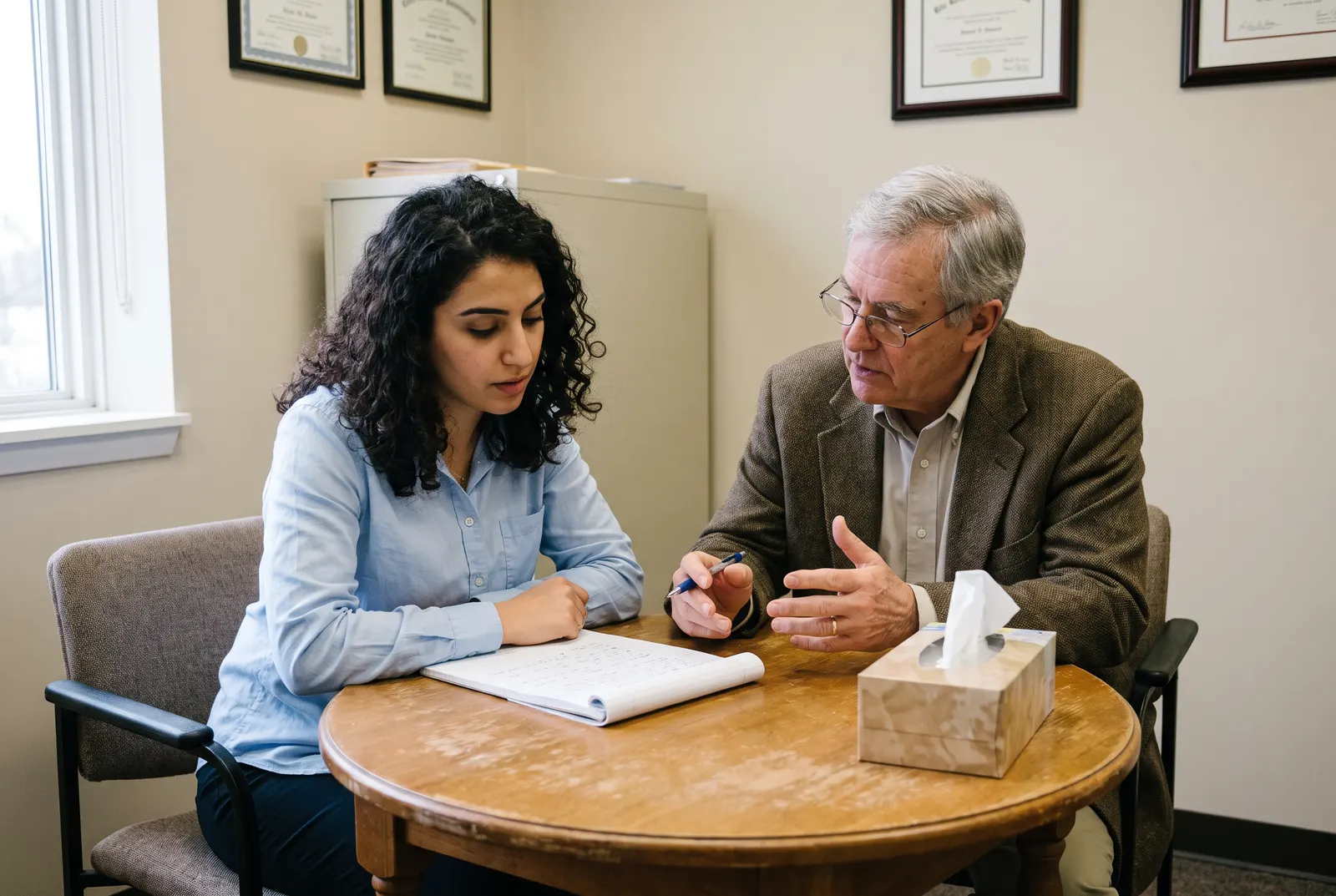 Practicum & Internship GuideCACREP requires 700 clinical hours across practicum and internship. Learn direct hour rules, supervision limits, and how to land a local site.
Sources
7 references
- Counseling Compact Official Map and Implementation Status
- Counseling Compact Frequently Asked Questions
- National Counselor Examination (NCE) Overview
- National Clinical Mental Health Counseling Examination (NCMHCE) Overview
- National Certified Counselor (NCC) and CCMHC Credentials
- American Association of State Counseling Boards (AASCB)
- Occupational Employment and Wage Statistics (May 2025)
All sources retrieved .