

Talk to anyone who dropped out of a clinical mental health counseling master’s program or delayed graduation by a full year, and the culprit is almost never psychopathology exams or research methods papers. It is the 700-hour unpaid clinical wall that arrives in your final 12 months.
Under the 2024 CACREP Standards, every accredited CMHC graduate must complete a 100-hour practicum (including at least 40 direct client contact hours) followed by a 600-hour internship (including at least 240 direct client contact hours), supervised weekly by both an onsite licensed clinician and university faculty. Even if you complete every academic class from your kitchen table in a fully online track, those 700 clinical hours happen in real behavioral health clinics, hospitals, group practices, or approved telehealth agencies. Surviving that stretch without wrecking your finances or your health takes honest scheduling math starting a full year before practicum opens.
The Real Weekly Hour Math Nobody Puts in the Brochure
Admissions pages routinely summarize internship as “about 15 to 20 hours per week over two semesters.” On paper, dividing 600 total hours across two 15-week semesters equals 20 hours per week. In actual clinical practice, two hidden friction points push the real commitment higher:
-
The direct-hour bottleneck. Earning 600 total hours is easy because charting, intake reviews, staff meetings, case consultations, and weekly supervision all count as indirect hours. Earning 240 direct client contact hours (face-to-face or live synchronous telehealth therapy and co-led groups) is the real constraint. In community mental health clinics, client no-show and late-cancellation rates commonly run 15% to 25%. If you schedule 8 clients per week expecting to finish 240 direct hours across 30 weeks, no-shows leave you 40 to 60 hours short right before graduation.
-
Supervision and seminar hours on top of site hours. CACREP mandates at least 1 hour per week of individual or triadic site supervision plus an average of 1.5 hours per week of university group supervision seminar. Add commuting time, clinical documentation, and one concurrent graduate elective, and a two-semester internship quickly feels like a 26-to-30-hour-per-week commitment.
Look at how pacing your 600-hour internship across two semesters versus three semesters transforms a working adult’s weekly calendar:
| Internship Split | Total Weeks (Approx.) | Weekly Site Hours Needed | Weekly Direct Sessions to Book (Accounting for 20% No-Shows) | Compatibility With Paid Work |
|---|---|---|---|---|
| 2 Semesters (Fall + Spring) | 30 weeks | 20 to 22 hours/week | 10 to 11 client slots/week | Best paired with 20-hour part-time job or flexible self-employment |
| 3 Semesters (e.g., Fall + Spring + Summer) | 42 to 45 weeks | 14 to 16 hours/week | 7 to 8 client slots/week | Realistic alongside a 32-to-40-hour flexible or remote full-time job |
| 4 Quarter Terms (Quarter-Credit Schools) | 40 to 44 weeks | 15 to 17 hours/week | 7 to 8 client slots/week | Steady lighter weekly load across a full calendar year |
Before enrolling in any CMHC program, ask the clinical coordinator a single decisive question: Can students split the 600-hour internship across three semesters instead of two? Many schools allow a three-term internship split (or offer a zero-credit or one-credit continuation course if you need an extra summer to clear direct hours), which drops your weekly clinical load by roughly a third and keeps full-time rent money flowing.
By the Numbers
- 57 Programs Ranked
- $740 Median Master's Cost per Credit
Source: School program pages, November 2026
Four Practical Ways Working Adults Keep Paying Rent During Internship
Students who finish their 700 hours intact rarely rely on sheer willpower. They engineer one of four structural arrangements months before practicum starts:
1. Target Evening, Weekend, and Outpatient Group Practice Sites
Hospital inpatient units and school-based counseling sites run strictly Monday through Friday from 8:00 a.m. to 4:00 p.m., colliding head-on with a day job. Private group practices, intensive outpatient programs (IOPs), and community sliding-scale clinics, by contrast, face their heaviest client demand between 4:00 p.m. and 8:30 p.m. on weekdays and 9:00 a.m. to 4:00 p.m. on Saturdays because working adults and teenagers want after-work and after-school therapy slots.
A student who works a remote or daytime job from 7:30 a.m. to 3:30 p.m., sees clients three evenings a week plus Saturday mornings, and co-leads one two-hour evening IOP group can collect 16 to 18 hours per week (including 9 to 10 direct client hours) without quitting their primary paycheck. Group therapy is an especially powerful multiplier: co-facilitating a single two-hour evening skills group counts as two direct clinical hours every week with zero single-client no-show risk.
2. Use a Workplace-Separated Clinical Placement
If you already work at a community behavioral health center, residential treatment facility, hospital network, or multi-site nonprofit as a case manager, recovery specialist, or behavioral health technician, ask your clinical director early about an internal internship.
CACREP and university handbooks prohibit “double-dipping” (counting your normal paid non-counseling job hours as clinical counseling internship) and forbid your administrative boss from serving as your clinical supervisor. However, most departments do approve workplace internships when three clean walls are documented in writing:
- Your internship hours happen inside a separate clinical unit or outpatient program with a distinct client caseload.
- Your clinical supervisor is a fully licensed LPC, LMHC, LCSW, or psychologist outside your direct employment chain of command.
- Your timecard clearly separates paid job shifts from clinical internship blocks.
Many behavioral health employers gladly rearrange an existing employee’s 40-hour workweek into four 8-hour paid shifts plus two clinical internship days, keeping health insurance benefits intact while training a future licensed clinician they already trust to hire upon graduation.
3. Build a Year-One Cash Bridge Plus Low-Tuition Federal Loan Room
If your paid job has inflexible daytime hours and you must drop to part-time work during Year 3, treat the unpaid internship like a planned 9-month sabbatical. Start funding a dedicated savings account during your first term of classes, and pair it with a low-tuition public or flat-rate program.
As detailed in our breakdown of budgeting under the $20,500 federal loan cap, choosing a CACREP degree at $25,740 to $37,000 total tuition keeps Year 3 tuition around $8,580 to $12,300, leaving $8,200 to $11,920 in federal Direct Loan headroom during your clinical year so you can cut paid shifts without turning to high-interest credit cards.
4. Hunt Early for Stipends, Paid Fellowships, and Apprenticeships
Paid CMHC internships are rare, yet students routinely miss the ones that exist because application windows close 6 to 9 months ahead of placement:
- HRSA BHWET stipends. Public university counseling departments holding federal Behavioral Health Workforce Education and Training grants often pay $10,000 stipends to final-year interns placed at qualifying rural or high-need community clinics.
- Registered apprenticeships. Schools such as The College of New Jersey run U.S. Department of Labor Registered Apprenticeship tracks that pay students during practicum and internship.
- County behavioral health stipends. Several state and county mental health systems (particularly in California, Washington, and rural Midwest counties) fund $5,000 to $15,000 clinical intern stipends tied to a one-year post-graduation service commitment at a public clinic.
- Private practice fee-split interns (where state law allows). A minority of states permit master’s-level interns under direct supervision to receive modest stipends or W-2 hourly pay at group practices; verify your state licensing board’s rules before accepting any client-fee compensation.
How University Placement Support Differs Dramatically Between Schools
Not every CMHC program treats site placement the same way, and admissions recruiters rarely volunteer how much legwork falls on your shoulders. Compare how real programs in our directory structure field training:
-
Dedicated placement teams and regional networks. University of Massachusetts Global staffs a dedicated field support team to help students locate local clinics, and John Carroll University places students across established regional partner agencies.
-
Telehealth practicum bridges. University of Holy Cross delivers its initial 100-hour practicum via telehealth through its campus training center before students transition to a local 600-hour community internship, cutting early logistical stress in half.
-
Extra clinical hours for stricter states. Sacred Heart University provides an optional 300-hour Advanced Internship II course (CMH 680) for students targeting states whose licensing statutes exceed the 700-hour CACREP baseline.
-
Student-sourced approval models. Many nationwide online tracks (such as Grace College and similar distance programs) expect you to locate, cold-email, and interview with local behavioral health clinics yourself, then submit the site and supervisor credentials for university approval.
Neither model is automatically bad, provided you know which one you are signing up for before paying tuition. If you live in a rural county with only two community clinics, enrolling in a purely student-sourced program without first checking whether those two clinics accept interns from out-of-state universities is a major gamble.
Related Rankings
- Online CMHC for Working AdultsFlexible online clinical mental health counseling master's degrees designed around full-time work schedules, evening sessions, and multiple starts.
- Part-Time Online CMHC ProgramsOnline clinical mental health counseling master's degrees with published part-time tracks for students balancing work and clinical hours.
- 100% Online CMHC ProgramsClinical mental health counseling master's degrees with zero campus travel requirements, ranked on cost, CACREP status, and outcomes.
- Best Online CMHC ProgramsOnline clinical mental health counseling master's programs ranked by real per-credit cost, CACREP accreditation, residencies, and outcomes.
Your Nine-Month Pre-Practicum Placement Playbook
If your program expects you to source your own local clinic, waiting until two months before practicum guarantees panic. Follow a structured nine-month countdown instead:
-
Month 9 before practicum: Pull your university’s existing affiliation list. Request the list of clinics within 45 miles of your zip code that already hold an active legal affiliation agreement with your school. Pre-approved sites skip 8 to 16 weeks of university contract negotiations.
-
Month 8: Build a 25-clinic outreach tracker. Combine existing university partners with Psychology Today group practices, local FQHCs, community mental health centers, college counseling centers, hospice agencies, and outpatient addiction clinics.
-
Month 7: Send crisp, specific clinical inquiry emails. Clinic directors delete generic “do you take interns?” emails. Send a five-sentence note stating your university, CACREP status, exact start and end dates, weekly hours available (highlight evening or weekend availability!), and your supervisor license requirement (e.g., an independently licensed LPC, LMHC, LCSW, or psychologist with at least two years post-licensure experience).
-
Month 5 to 6: Interview the site as rigorously as they interview you. Never sign an internship agreement until you confirm five facts: how many active clients new interns receive in their first 30 days, whether group therapy co-facilitation is available to protect direct hours, whether your site supervisor actually has a protected 60-minute weekly slot for individual supervision, whether telehealth sessions are allowed under your state board’s student rules, and whether evening/weekend hours have licensed onsite backup for client crises.
-
Month 4: Submit university site paperwork and liability insurance immediately. Legal review of a new affiliation agreement routinely stalls for two months over indemnification clauses. Getting paperwork into the field office four months early gives you a safety buffer if your first-choice agency balks at your university’s contract terms.
Protecting Your Health and Licensing Timeline
Burnout during internship happens when students quietly drown in 55-hour combined weeks and refuse to adjust course loads until a clinical supervisor intervenes. Set two firm guardrails early:
- Drop extra academic electives during your 600-hour internship. Front-load your electives into Years 1 and 2 so your internship semesters consist strictly of Internship I/II plus weekly group supervision and capstone exam prep.
- Audit your logged hours every Friday night. Track direct hours, indirect hours, and weekly supervision signatures inside Tevera or Time2Track every single week rather than reconstructing three months of calendars at finals. Catching a slow client ramp-up in Week 4 lets you add a therapy group or a second placement site in time to graduate on schedule.
For the complete regulatory breakdown of CACREP hour minimums and supervisor qualifications, read our CMHC practicum and internship guide, and compare flexible schedules on our online CMHC programs for working adults and part-time online CMHC programs lists.
Frequently Asked Questions
Can You Keep a Full-Time Job During a 600-Hour CMHC Internship?
Why Do 240 Direct Client Hours Take So Much Longer Than Expected?
Are Paid Clinical Mental Health Counseling Internships Possible?
Can You Complete Your CMHC Internship at Your Current Workplace?
How Early Should Online CMHC Students Start Searching for a Practicum Site?
Keep Reading
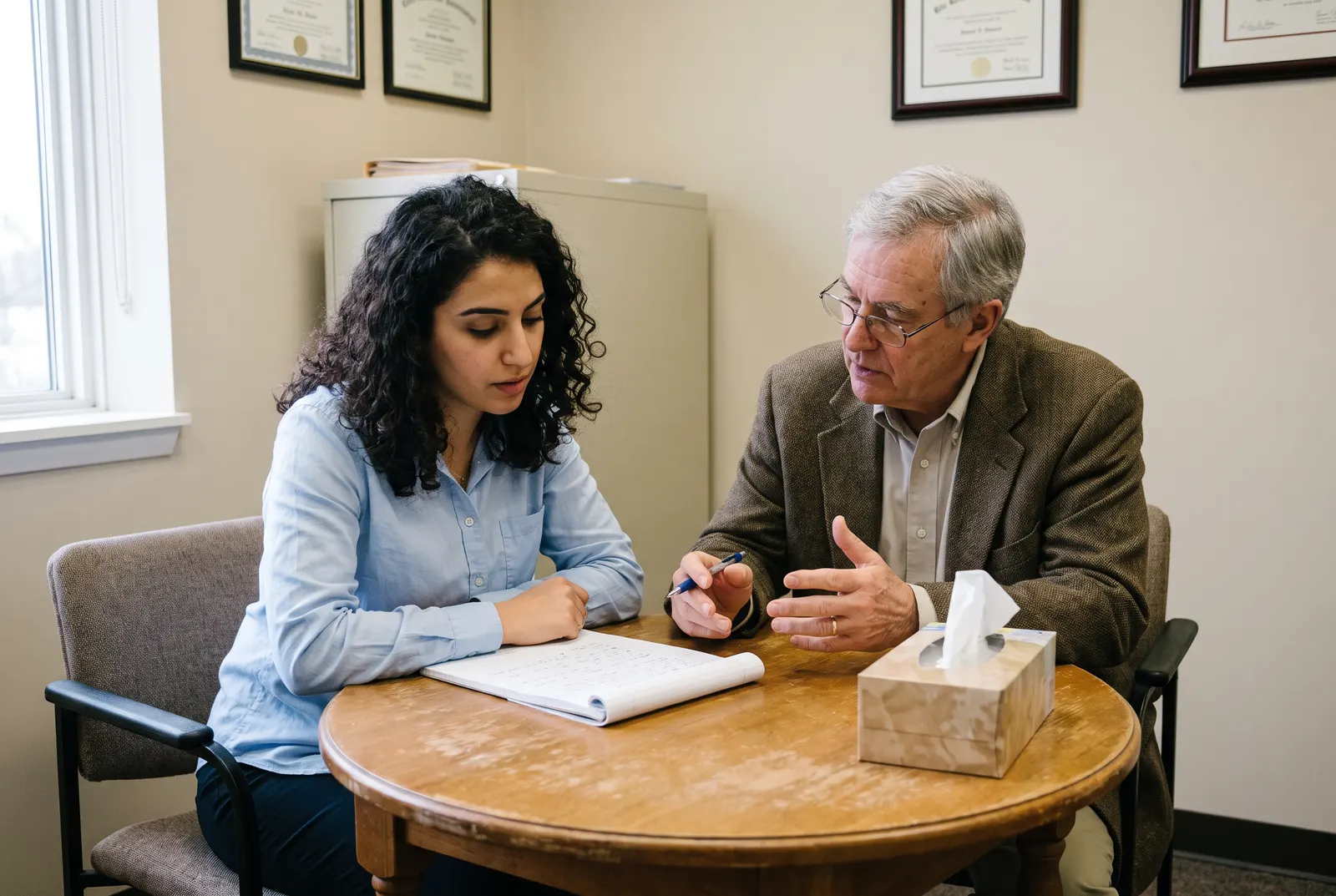 Practicum & Internship GuideCACREP requires 700 clinical hours across practicum and internship. Learn direct hour rules, supervision limits, and how to land a local site.
 Budgeting Under the $20,500 Loan CapPractical tuition math, pacing schedules, and aid strategies for paying for a 60-credit CMHC degree under the July 2026 $20,500 annual federal loan cap.
 Hidden Online Residency CostsCompare the real travel costs of online CMHC residencies vs. 100% online video intensives after CACREP's July 1, 2026 Policy A.2.e synchronous rule.
 How to Choose a CMHC ProgramYou can compare CMHC master's programs on CACREP status, real per-credit tuition, campus travel, and state licensure rules before applying.