
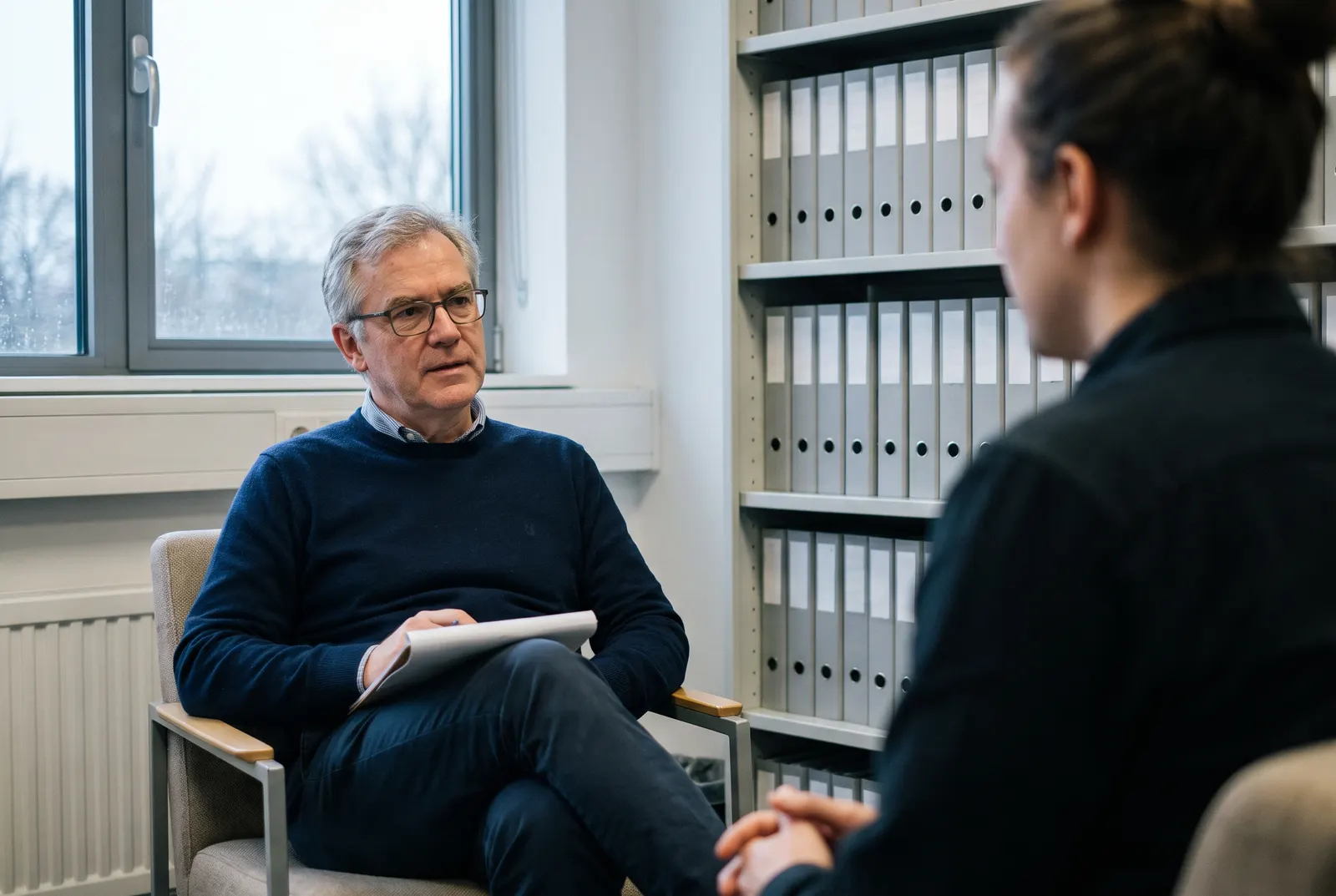
If you want to know how to become a mental health counselor, plan on earning a 60-credit clinical mental health counseling master’s degree, finishing 700 supervised graduate clinical hours, passing a national licensing exam, and logging 2,000 to 4,000 supervised post-master’s hours. A bachelor’s degree alone won’t qualify you to provide independent psychotherapy or bill insurance.
What Does a Mental Health Counselor Actually Do?
Television shows make therapy look like fifty quiet minutes of nodding on a leather couch. Real clinical work is far more structured. You work as a licensed behavioral health clinician trained to run formal biopsychosocial intakes and mental status evaluations, then establish clinical diagnoses and build measurable treatment plans.
Day to day, a mental health counselor treats clients managing depression and anxiety disorders alongside post-traumatic stress, acute grief, or sudden life crises. You apply evidence-based protocols like cognitive behavioral therapy and dialectical behavior therapy alongside acceptance and commitment therapy or trauma-focused interventions. You track symptom progress over weeks and months so sessions stay anchored to clinical goals.
Heavy paperwork happens outside the therapy room. Mental health counselors write clinical progress notes that establish medical necessity for health insurers. You also coordinate care with psychiatrists managing medication, consult with primary care doctors, write suicide safety plans, and file mandatory reports when a child or vulnerable adult faces harm.
One legal boundary holds nationwide. Mental health counselors cannot prescribe medication. When a client needs psychiatric pharmacology alongside psychotherapy, you coordinate with a psychiatrist or psychiatric nurse practitioner while you continue delivering talk therapy and behavioral skill coaching.
By the Numbers
- $59,350 Mental Health Counselor Median Pay
- $28.53 Median Hourly Wage
- 491,930 Jobs Nationwide
Source: BLS OEWS, May 2025
Mental Health Counselor vs. Social Worker vs. Psychologist
Pick the right clinical license before spending two to three years in graduate school. People often treat mental health counselors and clinical social workers as interchangeable, or confuse both with doctoral psychologists, yet each path trains you for slightly different work.
| Career Path | Degree Floor | Core Clinical Focus | Common Independent License |
|---|---|---|---|
| Mental Health Counselor | 60-credit M.A. or M.S. in CMHC | Individual psychotherapy and clinical diagnosis | LPC, LMHC, LCPC, LPCC, or LCMHC |
| Clinical Social Worker | M.S.W. (Master of Social Work) | Psychotherapy plus case management and systems | LCSW or LICSW |
| Clinical Psychologist | Ph.D. or Psy.D. | Psychotherapy plus formal psychological testing | Licensed Psychologist |
| Marriage & Family Therapist | M.A. or M.S. in MFT or CMHC | Relational therapy with couples and families | LMFT |
If you want direct psychotherapy training without spending five to seven years in a doctorate, a clinical mental health counseling master’s is the most focused route. Social work degrees allocate more coursework to macro policy and community resource coordination. Counseling programs devote almost all 60 credits to clinical interviewing and psychopathology alongside group counseling and supervised direct client hours.
If couples and family systems interest you most, compare this track with our marriage and family therapist guide. For a closer look at state licensing acronyms and interstate rules, read our licensed professional counselor overview.
Timeline to Become a Mental Health Counselor
Most prospective students underestimate the gap between graduation day and independent practice. Earning the master’s degree puts you at the starting line of supervised employment, not the finish line. The step-by-step licensure path covers each stage with its hours, exams and costs.
Step 1: Finish Any Accredited Bachelor’s Degree
You need an accredited four-year bachelor’s degree to enter graduate counseling school. Undergraduates often start in psychology or sociology, though counseling departments regularly admit teachers and nurses alongside business analysts and career changers from unrelated majors.
Admissions committees weigh undergraduate GPA and personal statements alongside faculty interviews and reference letters more heavily than your major title. Many programs skip standardized tests altogether. Compare test-optional tracks on our no-GRE online CMHC programs list.
Step 2: Complete a 60-Credit Master’s Degree in CMHC
State boards align licensure around a 60-semester-credit (or 90-quarter-credit) graduate counseling degree. Under the 2024 CACREP Standards, which took effect July 1, 2024 with full compliance required by July 1, 2026, Section 1.J establishes that 60-semester-hour floor for all accredited entry-level programs.
Full-time students finish 60 credits in two to three years. Part-time students balancing a full-time job usually need three to four years, especially once clinical fieldwork starts. Many online tracks include one or two short in-person skills residencies, though our 100% online CMHC programs list highlights zero-residency options.
Across verified CMHC master’s programs, median tuition is $740 per credit and $45,090 in estimated total tuition, with published per-credit rates starting at $347. Comparing published tuition on our cheapest online CMHC programs page helps keep debt manageable before your lower-paid associate years begin.
Step 3: Log 700 Supervised Graduate Clinical Hours
You cannot earn a licensure-track counseling degree purely behind a laptop. Under 2024 CACREP Standards Section 4, every student completes at least 700 supervised clinical clock hours at an approved local site, including at least 280 direct client service hours.
Practicum (100 total hours): You spend one full academic term seeing real clients for at least 40 direct client hours under weekly supervision. Extra hours logged during practicum cannot carry over toward internship minimums.
Internship (600 total hours): Spread across two or three terms, you log at least 240 direct client hours while carrying an active caseload. During either practicum or internship, Section 4.E also requires you to lead or co-lead a counseling or psychoeducational group.
Plan your personal finances around that final clinical year before enrolling. Most graduate practicum and internship placements pay $0 while you still pay tuition per credit. Working 15 to 25 clinic hours a week alongside classes makes holding a rigid 40-hour daytime job tough.
Step 4: Pass Your State’s National Licensing Exam
Most state counseling boards rely on one or both exams administered by the National Board for Certified Counselors (NBCC).
National Counselor Examination (NCE): A 200-item multiple-choice exam (160 scored items plus 40 unscored pretest items) lasting 4 hours and 15 minutes at Pearson VUE centers or via online proctoring where boards allow it.
National Clinical Mental Health Counseling Examination (NCMHCE): A clinical simulation exam built on 10 narrative case studies with 9 to 15 multiple-choice questions per case (130 to 150 total questions) lasting 3 hours and 45 minutes plus an optional 15-minute break.
Several states also require a brief jurisprudence exam covering state confidentiality statutes. Check your board’s exact exam rule before registering so you don’t pay twice.
Step 5: Complete Associate Supervision for Independent Licensure
After graduating and passing your initial exam, your state board issues a provisional associate license (such as LPC-A, LPCC-A, LMHC-Intern, or LCMHCA). You then work as a paid clinician under a board-approved supervisor.
State boards set post-master’s minimums between 2,000 and 4,000 supervised hours over two to three years. A widely used benchmark across state boards and TRICARE is 3,000 total clinical hours (often around 2,000 direct client hours) plus at least 100 face-to-face supervision hours over two years. Once the board verifies your log, you hold an unrestricted independent license.
Why CACREP Accreditation Shapes Your Career Options
Counseling degree pages feature two programmatic accreditors: CACREP and MPCAC. CACREP accredits over 969 master’s and doctoral counseling programs across 483 U.S. colleges and universities, making it the primary national benchmark.
Skipping CACREP can limit your career mobility later. Several states mandate CACREP outright for new applicants, and non-CACREP graduates relocating across state lines often run into slow course-by-course transcript reviews.
U.S. Department of Veterans Affairs (VA): The VA employs counselors as Licensed Professional Mental Health Counselors (LPMHCs) and requires a CACREP-accredited master’s degree plus an unrestricted independent state license for full-performance roles.
TRICARE: The Military Health System authorizes independent counselors as reimbursed providers, tying qualification to a CACREP-accredited master’s (or strict equivalent), an unrestricted state license, NCE or NCMHCE passage, and 3,000 supervised hours with 100 supervision hours over two years.
NBCC National Certified Counselor (NCC): CACREP graduates qualify immediately after passing the NCE or NCMHCE without post-graduate work experience. Non-CACREP applicants generally must document 3,000 post-graduate hours and 100 supervision hours over 24 months.
If you want VA hospitals and smooth relocation to stay open, start your school search on our CACREP-accredited CMHC programs list.
Where Mental Health Counselors Work
An independent counseling license opens jobs across the behavioral healthcare continuum. Your work setting shapes your caseload intensity and whether your employer pays for weekly supervision.
Community Behavioral Health Centers hire the largest share of newly graduated associate counselors. You work with high-acuity Medicaid clients and usually receive free weekly supervision toward licensure. Starting salaries sit near the bottom of the wage curve, though loan-repayment programs often help offset lower early pay.
Outpatient Group Practices serve commercially insured and self-pay clients dealing with depression and anxiety alongside relationship conflict and major life transitions. Joining a group practice lets you skip business overhead while splitting session revenue with the practice owner.
Hospitals and Integrated Primary Care Clinics place counselors in psychiatric units and emergency crisis teams, plus partial hospitalization programs and primary care offices. Hospital systems usually pay stronger W-2 salaries and full medical benefits compared with small agencies.
Veterans Affairs and Military Programs hire independently licensed counselors for trauma recovery and behavioral medicine teams. Military OneSource also contracts independent counselors for short-term non-medical sessions with service members and their families.
Solo Private Practice becomes legal once your independent license clears. You cap your own caseload and control your weekly schedule, while absorbing office rent and electronic health record fees, plus malpractice insurance and self-employment taxes yourself.
Related Rankings
- Best CMHC Master's ProgramsCompare accredited clinical mental health counseling master's programs ranked on cost, earnings, completion, CACREP status, and flexibility.
- Best Online CMHC ProgramsOnline clinical mental health counseling master's programs ranked by real per-credit cost, CACREP accreditation, residencies, and outcomes.
- CACREP-Accredited CMHC ProgramsCACREP-accredited clinical mental health counseling master's degrees meeting the 60-credit and 700-hour clinical standard, ranked by score.
- Cheapest Online CMHC ProgramsThe most affordable online clinical mental health counseling master's degrees, ordered by verified per-credit tuition and 60-credit cost.
How Much Do Mental Health Counselors Make?
Read federal counselor wage statistics with two important caveats. In May 2025, the BLS Occupational Employment and Wage Statistics (OEWS) release reported mental health counselors under SOC 21-1018 (Substance Abuse, Behavioral Disorder, and Mental Health Counselors) across 491,930 salaried positions.
- 10th Percentile: $38,940 per year
- 25th Percentile: $47,100 per year
- Median (50th Percentile): $59,350 per year ($28.53 per hour)
- Mean Annual Wage: $64,440 per year
- 75th Percentile: $76,530 per year
- 90th Percentile: $97,590 per year
First, SOC 21-1018 groups bachelor’s-level substance abuse staff and associate-tier counselors near the 10th and 25th percentiles alongside licensed hospital clinicians and supervisors at the 75th and 90th percentiles. Second, BLS OEWS surveys measure salaried and wage employees only, so self-employed private-practice clinicians do not appear in those counts or percentiles.
Geography shifts pay just as sharply as setting. Alaska posted the highest state median for SOC 21-1018 in May 2025 at $80,770 ($114,650 p90 across 1,290 jobs), followed by Oregon at $74,590 (8,160 jobs) and New Mexico at $74,100 (2,420 jobs). Washington reached $68,910 across 14,250 jobs.
At the bottom of the published table, Louisiana reported a $37,910 median (6,420 jobs), Mississippi sat at $46,990 (2,090 jobs), and Alabama came in at $47,310. Large markets show wide internal spreads. California employs 75,610 salaried counselors at a $59,250 median while its 90th percentile reaches $111,080, and Illinois sits at a $60,730 median with a $109,100 90th percentile across 20,250 jobs.
What a Realistic Week Looks Like as a Mental Health Counselor
Skip the highlight reel. Look at a full outpatient week for an independently licensed counselor carrying 26 scheduled client slots.
Monday and Tuesday carry heavy clinical volume. You open at 8:30 a.m. by running a 60-minute diagnostic intake for a new client experiencing panic attacks, then enter the DSM diagnosis and initial treatment plan before your 10:00 a.m. session. By 5:30 p.m., you have seen six clients and completed four of your six progress notes.
Wednesday breaks up solo sessions. You lead a 90-minute afternoon skills group for adults managing chronic anxiety and join a one-hour peer consultation team to staff a complicated trauma case. Late afternoon goes to submitting insurance authorizations so clients keep coverage.
Thursday runs late because working adults want evening appointments. You shift to an 11:00 a.m. to 7:30 p.m. schedule, seeing five individual clients plus one parent collateral session. A late cancellation hands you a welcome hour to finish Tuesday’s leftover notes.
Friday leans lighter on client hours. You see three morning clients and review weekly billing claims. After lunch, you spend an hour on continuing education coursework before closing your laptop by 3:00 p.m.
Honest Pros and Cons of Becoming a Mental Health Counselor
Every university brochure promises meaningful work. Few explain plainly why new clinicians burn out during year two. Weigh the tradeoffs before borrowing $45,090.
The Hard Parts to Plan For
Unpaid Graduate Fieldwork: Your 700-hour practicum and internship year usually pays $0 while you pay graduate tuition per credit. Saving cash ahead of time prevents mid-program financial panic.
The Associate Pay Dip: During your two to three supervised post-master’s years, agency pay frequently sits near the $38,940 to $47,100 range. If an employer doesn’t include clinical supervision, you may also pay an outside supervisor out of pocket weekly.
Documentation Fatigue: Writing insurance-compliant notes after five emotionally heavy sessions wears clinicians down faster than therapy itself. Falling behind turns Sunday afternoons into unpaid paperwork shifts.
Vicarious Trauma: Sitting with severe abuse histories and active suicide risk every week demands firm personal boundaries and consistent clinical support.
Why Experienced Clinicians Stay
Real Schedule Autonomy After Licensure: Independent licensure lets you shift to a four-day week, deliver telehealth from home, work part-time around family caregiving, or run a solo practice on your own schedule.
Broad Setting Mobility: One 60-credit CMHC degree opens doors across hospitals and community clinics, plus college counseling centers and private practice, without returning for a doctorate.
Growing Interstate Portability: As of November 2026, 41 jurisdictions (40 states plus DC) have enacted the Counseling Compact, with 11 live states issuing multistate privileges through CompactConnect.
How to Pick Your Next Step
Start by reading your state licensing board’s exact rules for credit minimums and required exams. Next, compare CACREP-accredited programs on real per-credit cost and residency travel before applying.
Explore verified degrees on our best CMHC master’s programs list or compare flexible remote options on our best online CMHC programs ranking. You can also compare specialized substance use careers in our addiction counselor guide.
Mental Health Counselor Pay by State
In May 2025, the Bureau of Labor Statistics reported a median annual wage of $59,350 for mental health counselor nationwide, with the middle half earning between $47,100 and $76,530. About 491,930 people held these jobs.
Alaska had the highest published state median at $80,770, and Louisiana the lowest at $37,910. The table lists every state where BLS publishes a median for this occupation.
See the Wage Table for All 51 States
| State | Median | 10th Percentile | 90th Percentile | Jobs |
|---|---|---|---|---|
| Alaska | $80,770 | $58,240 | $114,650 | 1,290 |
| Oregon | $74,590 | $49,860 | $102,830 | 8,160 |
| New Mexico | $74,100 | $48,900 | $113,420 | 2,420 |
| Washington | $68,910 | $47,220 | $110,580 | 14,250 |
| North Dakota | $68,630 | $43,270 | $86,630 | 1,290 |
| Arizona | $65,300 | $44,520 | $95,210 | 9,990 |
| Rhode Island | $65,120 | $43,960 | $98,440 | 2,170 |
| Utah | $63,890 | $35,410 | $106,080 | 6,320 |
| Nebraska | $63,770 | $42,400 | $109,610 | 2,170 |
| Connecticut | $63,590 | $44,080 | $99,540 | 7,540 |
| Idaho | $63,360 | $36,400 | $98,760 | 2,990 |
| Wyoming | $62,980 | $36,960 | $103,150 | 910 |
| New Jersey | $62,820 | $40,630 | $104,310 | 14,210 |
| Texas | $62,630 | $37,650 | $95,910 | 21,400 |
| Colorado | $62,390 | $44,060 | $100,020 | 14,920 |
| Wisconsin | $62,220 | $46,510 | $94,640 | 8,340 |
| Vermont | $61,810 | $47,820 | $80,690 | 1,120 |
| Michigan | $61,690 | $38,490 | $94,400 | 10,100 |
| Iowa | $60,880 | $44,450 | $102,890 | 3,530 |
| Illinois | $60,730 | $43,010 | $109,100 | 20,250 |
| District of Columbia | $60,450 | $43,060 | $107,980 | 1,260 |
| Hawaii | $60,090 | $48,460 | $104,790 | 2,110 |
| Maine | $59,970 | $43,310 | $89,220 | 1,930 |
| Massachusetts | $59,890 | $43,180 | $96,200 | 18,190 |
| Virginia | $59,880 | $39,730 | $100,040 | 17,940 |
| Maryland | $59,530 | $44,050 | $91,980 | 9,730 |
| Kansas | $59,470 | $37,910 | $85,860 | 2,600 |
| New York | $59,450 | $42,410 | $90,590 | 26,770 |
| Oklahoma | $59,350 | $35,350 | $92,870 | 5,150 |
| California | $59,250 | $44,640 | $111,080 | 75,610 |
| Montana | $59,000 | $36,840 | $83,640 | 1,820 |
| Georgia | $58,960 | $37,390 | $90,980 | 9,600 |
| Minnesota | $58,780 | $45,250 | $77,320 | 7,110 |
| Ohio | $58,360 | $39,010 | $83,730 | 18,020 |
| Nevada | $57,210 | $42,920 | $98,010 | 1,810 |
| Missouri | $56,910 | $37,650 | $89,400 | 8,130 |
| Florida | $56,790 | $39,430 | $84,410 | 29,750 |
| Delaware | $56,020 | $36,940 | $80,710 | 1,700 |
| North Carolina | $55,490 | $37,440 | $86,010 | 10,300 |
| New Hampshire | $54,840 | $38,480 | $81,050 | 3,690 |
| Kentucky | $54,190 | $35,150 | $83,070 | 7,690 |
| Indiana | $53,760 | $37,580 | $83,200 | 11,890 |
| South Dakota | $53,650 | $39,210 | $67,010 | 1,710 |
| South Carolina | $52,370 | $35,010 | $81,420 | 6,300 |
| Pennsylvania | $52,010 | $36,280 | $81,970 | 30,620 |
| Arkansas | $51,580 | $35,760 | $100,270 | 2,570 |
| Tennessee | $49,580 | $34,950 | $76,620 | 9,040 |
| West Virginia | $49,430 | $36,990 | $73,360 | 2,100 |
| Alabama | $47,310 | $34,420 | $76,510 | |
| Mississippi | $46,990 | $32,770 | $77,310 | 2,090 |
| Louisiana | $37,910 | $29,860 | $65,720 | 6,420 |
Frequently Asked Questions
How Long Does It Take to Become a Mental Health Counselor?
Can You Become a Mental Health Counselor Without a Psychology Degree?
How Much Do Mental Health Counselors Make in 2026?
Do You Need a CACREP-Accredited Degree to Practice?
Can Mental Health Counselors Diagnose Mental Health Disorders?
Keep Reading
 Licensed Professional CounselorLearn how to become a licensed professional counselor (LPC), from 60-credit CACREP training and NCE or NCMHCE exams to Counseling Compact portability.
 Addiction CounselorLearn how to become an addiction counselor, comparing CADC certificates vs. CMHC master's degrees, dual licensure, treatment settings, and BLS pay.
 Marriage & Family TherapistLearn how to become a marriage and family therapist (LMFT), comparing COAMFTE vs. CMHC degrees, relational clinical hours, and May 2025 BLS pay.
 Mental Health Counselor SalaryMental health counselors earn a $59,350 national median in May 2025 BLS data. Compare state wage gaps and verified CMHC tuition ROI.
 CMHC vs. MSW (LPC vs. LCSW)A CMHC master's trains you for clinical therapy while an MSW covers clinical work and macro systems. Compare exams, job settings, and wages.