
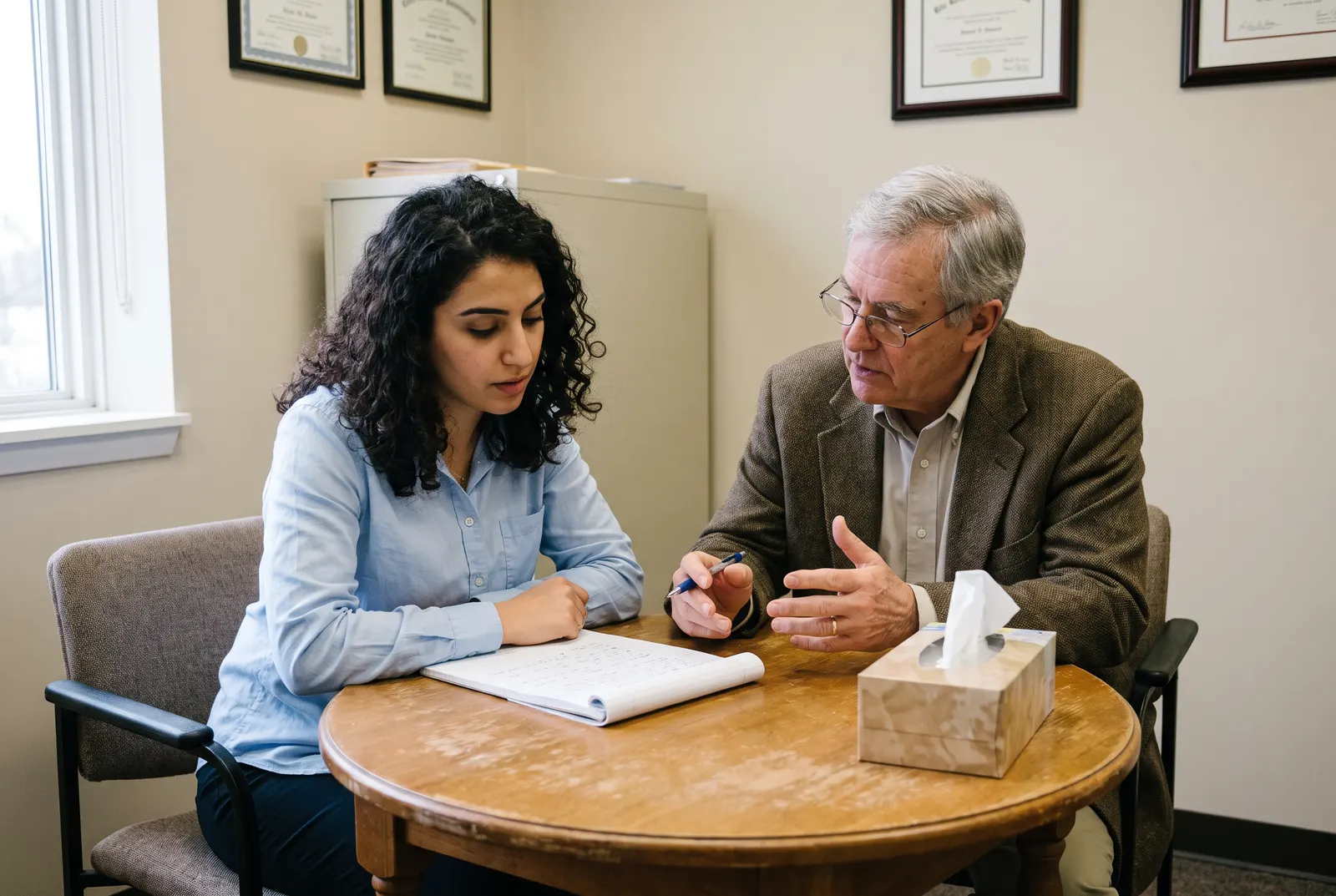
Your clinical mental health counseling practicum and internship require a minimum of 700 supervised clock hours under the 2024 CACREP Standards: 100 hours in practicum (including at least 40 direct client hours) and 600 hours in internship (including at least 240 direct client hours). You complete those hours in real behavioral health settings under an approved licensed supervisor, even when every single lecture in your degree is online.
Coursework rarely derails CMHC students. Field placement does. Finding an agency willing to take a trainee while clearing university affiliation contracts and fitting 20 unpaid clinical hours around a full-time job is the single hardest stretch of the master’s degree. Plan for that bottleneck in your first year instead of scrambling two months before practicum starts.
What Are the Exact 2024 CACREP Clinical Hour Rules?
Every CACREP-accredited clinical mental health counseling master’s follows Section 4 of the 2024 CACREP Standards (effective July 1, 2024, with full program compliance required by July 1, 2026). State licensing boards mirror these minimums closely, though several states stack extra requirements on top.
| Clinical Stage | Minimum Total Clock Hours | Minimum Direct Client Hours | Indirect Hours Allowed | Typical Duration |
|---|---|---|---|---|
| Practicum (Section 4.Q and 4.R) | 100 hours | 40 direct hours | Up to 60 indirect hours | 1 full academic term |
| Internship (Section 4.T and 4.U) | 600 hours | 240 direct hours | Up to 360 indirect hours | 2 to 3 academic terms |
| Combined Graduate Minimum | 700 hours | 280 direct hours | Up to 420 indirect hours | 3 to 4 academic terms |
Three strict rules inside Section 4 trip students up every semester:
-
No hour carryover from practicum to internship. Extra clock hours or extra client sessions logged during practicum cannot roll forward into your 600-hour internship balance. Even when you remain at the exact same clinic for both courses, your internship clock resets to zero on day one of Internship I.
-
Full academic term pacing. You can’t cram a 100-hour practicum into three intense weeks over winter break. CACREP requires practicum to span a full academic term so your clinical skills develop alongside weekly supervision.
-
Mandatory group counseling leadership. Under Section 4.E, you must lead or co-lead a counseling or psychoeducational group during either practicum or internship. If your clinic only books one-on-one sessions, ask your supervisor early how you will fulfill the group requirement before graduation.
How Real Programs Raise or Reshape Those Minimums
CACREP sets the floor, not the ceiling. Several programs in our directory require more direct hours or build specialized structures worth checking before you enroll:
-
Higher direct-hour minimums. Indiana Wesleyan University sets its 100-hour practicum floor at 50 direct hours instead of 40. Bellevue University requires 260 direct internship hours instead of 240, including at least 10 hours leading or co-leading group work.
-
Pre-practicum bridge courses. Grand View University and Keiser University insert a formal pre-practicum course before you see actual clients, and East Carolina University does the same through ADRE 6310.
-
Split practicum or accelerated internship options. University of the Southwest divides practicum into two 50-hour terms (COUN 5833 and COUN 5933). On the other end, Commonwealth University of Pennsylvania lets qualified students complete all 600 internship hours in a single intense semester to graduate a half-year earlier.
-
Extra hours for stricter states. Sacred Heart University offers an optional 300-hour Advanced Internship II course (CMH 680) for states with higher clinical floors. University of Western States builds 800 supervised clinical hours across five quarters directly into its MPCAC-accredited curriculum, and Fitchburg State University pairs 150 practicum hours across two courses with a 600-hour internship.
By the Numbers
- 57 Programs Ranked
- $740 Median Master's Cost per Credit
Source: School program pages, November 2026
Direct Client Hours vs. Indirect Clinical Hours
Students routinely underestimate how hard it is to hit 280 direct client hours compared to 700 total clock hours. Knowing exactly what counts keeps you from falling short in week twelve of a semester.
Direct client hours require real-time clinical interaction with actual clients. That includes conducting diagnostic intake interviews and individual therapy sessions, leading or co-leading counseling groups, running couples or family sessions, and handling live crisis interventions. Role-playing with classmates does not count toward CACREP’s 40 direct practicum hours or 240 direct internship hours.
Indirect clinical hours cover every professional duty that supports client care outside live sessions. You log indirect time for writing progress notes and biopsychosocial assessments, preparing treatment plans, and attending weekly site or faculty supervision. Multidisciplinary team staffings along with agency trainings and recorded-session reviews count as indirect hours too.
Client no-shows are the hidden schedule killer. If a community mental health clinic schedules eight clients on your Wednesday shift and three cancel at the last minute, you still worked an eight-hour day, yet you only earned five direct client hours. Build a buffer into your weekly schedule so winter flu season or holiday cancellations don’t force you to pay for an extra internship extension term.
How Weekly Supervision Works During Practicum and Internship
You never practice alone as a student counselor. CACREP mandates two parallel layers of weekly supervision throughout your clinical sequence: site supervision at your clinic and university faculty supervision through your program.
Look at how programs structure those weekly touchpoints in practice:
-
Individual or triadic supervision (1 hour per week). You meet one-on-one (or in a pair with one other student) for at least an hour every week with your approved onsite supervisor or faculty supervisor. You review active cases and examine session recordings where client consent permits, walking through clinical risk assessments together.
-
Faculty-led group supervision (1.5 hours per week). Every week you join a small cohort seminar led by a university faculty member. At Grand Canyon University and The College of New Jersey, plus University of Oklahoma, this seminar runs synchronously by video (or on campus) and requires weekly attendance. William & Mary schedules 2 to 3 hours per week of synchronous faculty supervision during clinical terms.
Who Can Serve as Your Site Supervisor?
Your clinic’s nicest therapist may not qualify to supervise you. Before you accept an internship offer, verify your proposed supervisor’s exact credentials against both your university handbook and your state board’s rules.
Most CACREP programs and state boards require a site supervisor to hold an independent clinical license (such as an LPC, LMHC, LCPC, LPCC, LCSW, LMFT, or licensed psychologist) along with at least two years of post-licensure clinical experience and training in clinical supervision. Some states tighten that further: Houston Christian University specifies supervision under a licensed psychologist or Texas LPC-S (Licensed Professional Counselor Supervisor), reflecting Texas BHEC board rules.
Never assume an associate-level counselor (LPC-A or LMHC-Intern) can sign off on your graduate hours. Have your program’s clinical coordinator verify the supervisor’s license number in writing before you see a single client.
What Does a Weekly Practicum and Internship Schedule Actually Look Like?
Working adults ask the same practical question first: can I keep my full-time job while completing practicum and internship?
During practicum, the math is manageable for most working adults. William & Mary breaks its 100-hour practicum down to roughly 8 to 10 hours per week across two 7.5-week minimesters. You can often cover that with one weekday afternoon, two evening shifts, or Saturday clinic hours.
During internship, the workload doubles. Splitting 600 hours across two standard 15-week semesters means roughly 20 hours per week onsite, matching the pacing listed by Antioch University-New England, University of Phoenix, and William & Mary (18 to 20 hours per week).
Add 1.5 to 3 hours of weekly faculty seminar plus another class, and a 40-hour day job turns into a 65-hour week very fast.
Look at three realistic ways students survive internship without burning out:
-
Stretch internship across three terms. Taking 200 hours per term instead of 300 drops your clinic commitment closer to 13 to 15 hours per week. Check schools on our part-time online CMHC programs list that support three-term internship splits.
-
Use a clinic with evening and weekend hours. Private group practices and intensive outpatient addiction clinics (plus many college counseling centers) stay open until 8 p.m. or run Saturday intakes.
-
Transition into a paid behavioral health role before internship. Working as a behavioral health technician or intake specialist lets some students complete clinical hours at their employer in a separate clinical counseling role under a separate clinical supervisor, provided both the university and state board approve the arrangement.
A handful of universities have also started tackling the unpaid-labor problem directly. The College of New Jersey offers paid practicum and internship tracks through a U.S. Department of Labor Registered Apprenticeship Program (RAP), though seats depend on partner employer availability.
Related Rankings
- Best Online CMHC ProgramsOnline clinical mental health counseling master's programs ranked by real per-credit cost, CACREP accreditation, residencies, and outcomes.
- CACREP Online CMHC ProgramsOnline CACREP-accredited clinical mental health counseling master's programs ranked by tuition, residencies, practicum support, and outcomes.
- Part-Time Online CMHC ProgramsOnline clinical mental health counseling master's degrees with published part-time tracks for students balancing work and clinical hours.
- Online CMHC for Working AdultsFlexible online clinical mental health counseling master's degrees designed around full-time work schedules, evening sessions, and multiple starts.
How to Land a Local Clinical Site Without Delaying Graduation
Online counseling students face a harsh reality that campus students rarely deal with: you are usually responsible for sourcing your own placement in your home zip code.
Some institutions provide stronger scaffolding than others. University of Massachusetts Global runs a dedicated field support team that helps students locate local sites, and John Carroll University maintains regional agency partnerships. Other schools, including Grace College and Theological Seminary, expect you to locate a qualifying local agency yourself and submit it through a formal candidacy review.
Follow this six-step timeline starting at least 9 to 12 months before your practicum term begins:
-
Request your school’s existing affiliation list first. Every university already holds active legal agreements with agencies where past students trained. Calling a clinic that already has a signed contract with your school shaves two months off onboarding.
-
Pull your state board’s site-supervisor criteria. Confirm whether your state mandates an LPC-S, accepts LCSW or LMFT supervisors, or caps telehealth direct hours.
-
Build a target list of 20 to 30 local settings. Mix community mental health centers and outpatient addiction clinics with private group practices and hospital behavioral health units. Nonprofit family service agencies and university counseling centers often take interns too, and small group practices usually sign contracts far faster than large hospital legal teams.
-
Pitch yourself like a reliable junior clinician. Send a concise one-page clinical resume highlighting relevant human-services work plus your exact start and end dates, required direct hours, and available days of the week.
-
Confirm caseload volume during the interview. Ask bluntly: “How many weekly direct client appointments did your last intern average during their first month?” An agency that cannot put at least 8 to 10 clients on your calendar during internship will leave you short of 240 direct hours.
-
Trigger the affiliation agreement and background clearances early. Legal counsel at hospitals and counties can sit on university affiliation contracts for 8 to 12 weeks. Complete state criminal clearances and child abuse registries plus TB tests and student malpractice insurance (often offered through ACA or AMHCA student memberships) well before your university’s registration cutoff.
Telehealth and Hybrid Clinical Exceptions
Don’t assume you can complete all 700 hours from your bedroom laptop. Most CACREP programs and state boards still require substantial in-person client contact at a brick-and-mortar agency.
A few universities use telehealth strategically for the introductory stage. University of Holy Cross delivers its 100-hour practicum via telehealth through its Thomas E. Chambers Counseling and Training Center before sending students to an approved local agency for the 600-hour internship. Before logging telehealth sessions at any private practice site, confirm in writing that your state licensing board counts virtual sessions toward initial licensure.
What Happens After You Finish Your 700 Graduate Hours?
Finishing your 700-hour graduate clinical sequence gets you across the graduation stage, not into solo private practice. Your next phase is post-master’s supervised clinical experience under a provisional or associate state license (such as LPC-A, LPCC-A, LMHC-Intern, or LCMHCA).
Across U.S. states, post-master’s requirements typically run 2,000 to 4,000 total supervised hours over two to three years, with 3,000 clinical hours and 100 hours of face-to-face clinical supervision serving as a common state and TRICARE benchmark. Many graduate interns convert their final internship agency directly into their first paid post-master’s associate job, which is one more reason to pick your internship site carefully.
If you’re still comparing schools and want strong clinical support alongside flexible coursework, review our best online CMHC programs and online CMHC programs for working adults lists, or walk through our guide to choosing a CMHC program before you apply.
Frequently Asked Questions
What Is the Difference Between CMHC Practicum and Internship?
Can Extra Practicum Hours Count Toward My 600-Hour Internship?
Are CMHC Practicums and Internships Paid or Unpaid?
Can You Complete Your CMHC Practicum or Internship Online via Telehealth?
What Happens If My State Requires More Than 700 Clinical Hours?
Keep Reading
 How to Choose a CMHC ProgramYou can compare CMHC master's programs on CACREP status, real per-credit tuition, campus travel, and state licensure rules before applying.
 CMHC vs. MSW (LPC vs. LCSW)A CMHC master's trains you for clinical therapy while an MSW covers clinical work and macro systems. Compare exams, job settings, and wages.
 LMHC vs. LPC vs. LPCCStates use LPC, LMHC, LCPC, LPCC, and LCMHC for independent counselors. Compare state titles, exams, Counseling Compact states, and BLS pay.