
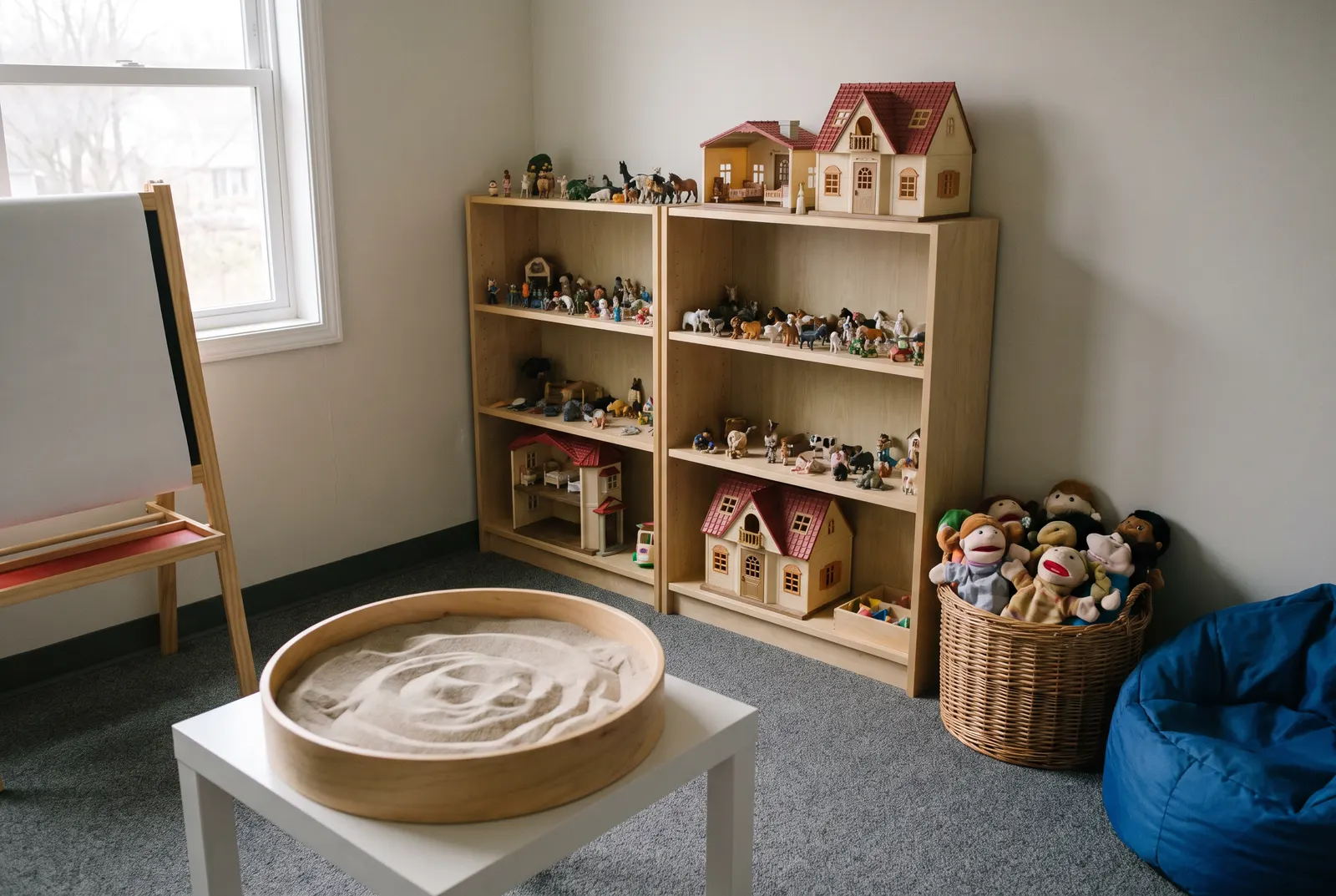
A play therapy certificate online can get you part of the way to the credential that matters, the Registered Play Therapist (RPT) from the Association for Play Therapy (APT). The RPT requires an independent clinical mental health license, 150 hours of play therapy instruction, 350 supervised client hours and 35 hours of supervision. Since April 1, 2025, at least 75 of those instruction hours must be in person, so no fully online certificate can cover the whole requirement on its own.
That in-person rule surprises a lot of people. Search results are full of online play therapy certificates, and many of them are good training. They just aren’t the RPT, and APT is specific about how much distance learning it will count.
What Is the Registered Play Therapist Credential?
The RPT is a practitioner credential from APT, a national professional association based in Clovis, California. APT says its credentialing program exists to set national standards for the competent practice of play therapy and to help the public find licensed clinicians with specialized training in it. APT offers three credentials: the RPT, the Registered Play Therapist-Supervisor (RPT-S) and the School Based-Registered Play Therapist (SB-RPT).
It is not a license. Your state board licenses you as an LPC, LMHC, LPCC or LCPC, and that license is what lets you treat children. Play therapy is a specialty you practice under that license. The RPT is the recognized way to show you trained for it.
University play therapy certificates are a different product again. A school may award a graduate certificate after four or five courses, and those courses can count toward the RPT’s instruction hours. The certificate alone gives you no APT credential.
By the Numbers
- 57 Programs Ranked
- $740 Median Master's Cost per Credit
Source: School program pages, November 2026
What Are the RPT Requirements?
APT’s Credentialing Standards, effective April 1, 2025, list five core requirements. All three training components have to be finished before you apply.
| Requirement | What APT Asks For | Notes |
|---|---|---|
| License | Current, active, unconditional state license for independent clinical practice | Counseling, MFT, psychiatry, psychology or social work |
| Degree | Master’s or higher clinical mental health degree in one of those five disciplines | Six graduate courses covering six core content areas |
| Play therapy instruction | At least 150 hours | At least 75 in person; no more than 75 non-contact |
| Supervised play therapy experience | At least 350 direct client contact hours | Under an RPT-S, across three phases |
| Play therapy supervision | At least 35 hours plus five session observations | Group supervision capped at 15 of the 35 hours |
| Time span | Each component spans at least two years and no more than ten | All within the ten years before APT receives the application |
| Application fee | $210 members, $340 non-members | Includes the first 12 months of activation |
| Annual renewal | $70 members, $190 non-members | Renewed every year |
| Continuing education | 24 play therapy CE hours every three years | At least 12 in person, 2 in cultural and social diversity |
The License
APT requires a current, active and unconditional individual state license to independently provide clinical mental health services. Specialty add-on licenses, such as addictions or art therapy licenses, don’t count by themselves. Limited, conditional or restricted licenses aren’t accepted either.
APT adds that a clinical license “should include two (2) years and 2,000 direct client contact hours of supervised clinical mental health experience.” For a counselor, that’s the post-graduate supervised period you already complete for independent licensure. Our LPC license requirements guide covers how that works state by state.
The Six Core Courses
Your graduate transcript has to show at least six graduate courses covering these core areas: Child Development; Theories of Personality; Principles of Psychotherapy; Child and Adolescent Psychopathology; Cultural and Social Diversity; and Legal, Ethical and Professional Issues.
Each course can count toward only one core area. Course titles don’t have to match. APT’s own examples include Life Span Development for child development, Counseling Theories for theories of personality, Counseling Process and Skills or Pre-practicum for principles of psychotherapy, and Diagnosis and Treatment for psychopathology. APT also offers a transcript review form if you want a ruling before you apply.
Play Therapy Instruction
The 150 instruction hours have to cover five primary areas. APT sets minimums for each: 5 hours of play therapy history, 55 hours of seminal or historically significant theories (at least 25 in a single theory), 50 hours of skills and methods, 25 hours of special topics, and 6 hours of cultural and social diversity in play therapy. The last 9 hours go wherever you choose.
APT recognizes three seminal branches, Cognitive-Behavioral, Humanistic and Psychodynamic, and ten historically significant theories or approaches, including Adlerian, Child-Centered, Filial, Gestalt, Jungian and Theraplay. Your training has to cover more than one of them.
A few rules cap where the hours come from. APT accepts no more than 8 instruction hours per day. It accepts no more than 135 clock hours from the same instructor in graduate coursework and no more than 100 from the same instructor in continuing education. CE must come from APT Approved Providers in good standing, and the certificate has to show the provider number.
Supervised Experience and Supervision
You need at least 350 direct play therapy client contact hours under the supervision of an RPT-S, plus at least 35 hours of play therapy supervision with at least five observed sessions. APT splits these into three phases with set ranges, so you can’t front-load everything into one year.
If your supervisor was not an RPT-S, APT asks for no less than 500 hours of play therapy experience and 50 supervision hours, with a maximum of 20 group supervision hours. Compare that with 350 hours and 35 supervision hours under an RPT-S, and finding a credentialed supervisor early is clearly worth the effort.
Supervision can be individual, in a group of 2 to 10 supervisees, in person or by phone or video. Observations can be live, by two-way mirror, recorded, by telehealth, transcribed or by mock session. Any supervisor who gives you 10 or more hours of supervision has to observe at least one session, and missing that observation voids the hours.
The Two to Ten Year Window
The timing rule shapes everything else. Instruction, supervised experience and supervision each have to stretch over at least two years and no more than ten, and every hour you submit must fall within the ten years before APT receives your application. A graduate play therapy course you took in your first semester counts, as long as you apply within that window. Hours from a workshop you took more than ten years before applying do not. If you start early in graduate school, keep every certificate and syllabus in one folder, because APT asks for copies of all of them.
Can You Earn a Play Therapy Certificate Online?
Yes, for half of the instruction. This is the rule that matters most for anyone searching for online options.
Effective April 1, 2025, APT requires at least 75 of the 150 instruction hours to be contact, or in-person, training. The other 75 can be contact or non-contact. APT counts all webinars, including live webinars, as non-contact. So a synchronous Zoom course with a live instructor still counts toward the 75 hour non-contact cap.
| Training Type | Minimum Toward the 150 | Maximum Toward the 150 |
|---|---|---|
| Contact or in-person training | 75 hours | No maximum |
| Non-contact training, all webinars including live ones | No minimum | 75 hours |
In practice, an online play therapy certificate works best as one piece of a plan. Use it for theory, history and special topics, then pick up in-person skills training at workshops or a university institute, where role-play and observed practice fit the format anyway.
Supervision is a different story. APT puts no limit on distance supervision by telephone or online, and observations can happen through telehealth or recordings. The in-person requirement applies to instruction, not to supervision.
The rule is recent. Programs that built their certificates before April 2025 may still describe them as covering “all 150 hours.” Ask how many of their hours APT would classify as contact training under the current standards.
How Does a CMHC Master’s Feed Into the RPT?
A clinical mental health counseling master’s helps in four separate ways, and it’s worth seeing them separately because APT counts each one differently.
It Supplies the Degree and Most Core Courses
A 60 credit CMHC program built to CACREP standards covers human development, counseling theories, counseling skills, diagnosis, multicultural counseling and ethics. Those map onto APT’s six core areas, and APT’s own examples for child and adolescent psychopathology include general courses such as Abnormal Psychology and Diagnosis and Treatment. A child and adolescent elective or concentration still helps, because it gives you clinical content you’ll use in play therapy and a cleaner match if a reviewer has questions.
Play Therapy Courses Count as Instruction
APT counts graduate play therapy coursework at 22.5 instruction hours per semester credit, as long as you took it as a matriculated student at an accredited university. You submit the syllabus and transcript. If you take the same course as a non-matriculated student, APT counts it as continuing education. Remember that a course you use for a core content area can’t also count toward the 150 hours.
Internship Hours Can Count as Experience
APT says clock hours from graduate internships and practicum aren’t eligible for instruction credit, but they may be included as supervised play therapy experience. They count when the play therapy work was supervised under APT’s rules. CACREP internships include 600 hours with at least 240 hours of direct service. If some of those direct hours are play therapy with children under an RPT-S, they can start your 350.
The Supervised Licensure Years Overlap
After graduation, you’ll spend roughly two or more years under supervision for independent licensure. If your job involves children and your supervisor or an outside consultant holds the RPT-S, play therapy hours and supervision can accumulate during that same period. That overlap is how most counselors reach the RPT without adding years to their timeline.
Related Rankings
- Child and Adolescent CMHCClinical mental health counseling master's degrees offering child, adolescent, youth, or family-centered clinical concentrations.
- Marriage and Family CMHCClinical mental health counseling master's degrees with marriage, couples, and family therapy concentrations for broader clinical scope.
- Best Online CMHC ProgramsOnline clinical mental health counseling master's programs ranked by real per-credit cost, CACREP accreditation, residencies, and outcomes.
- CACREP Online CMHC ProgramsOnline CACREP-accredited clinical mental health counseling master's programs ranked by tuition, residencies, practicum support, and outcomes.
Which CMHC Programs Offer Play Therapy or Child Tracks?
Few counseling master’s programs in our directory offer play therapy by name, so I looked at the child and adolescent options too. Our child and adolescent counseling programs ranking lists six programs with a child, adolescent or youth concentration.
Walden University is the clearest match. Its CACREP-accredited online MS in Clinical Mental Health Counseling offers a Play Therapy track among eight specializations, alongside a general program. Walden charges $550 per quarter credit and requires two four-day pre-practicum lab intensives, with a virtual option available. Ask Walden how APT would classify the track’s online courses, since webinar-style instruction falls under the 75 hour non-contact cap.
Grand View University in Iowa lists Introduction to Play Therapy among its courses in a 60 credit, CACREP-accredited degree at $610 per credit.
For child and adolescent concentrations without a play therapy label, Capella University offers a Child and Adolescent Counseling specialization in its 90 quarter credit program at $525 per credit. Commonwealth University of Pennsylvania has a Counseling Children and Adolescents track in a fully online 60 credit degree at $613 per credit, including a CMHC562 Child and Adolescent Counseling course. Marquette University offers a Child and Adolescent Counseling track in its fully online 60 credit program at $1,080 per credit. Northwestern University includes an optional Child and Adolescent Specialization within its required courses. Palo Alto University offers a Marriage, Family, and Child Counseling emphasis for students who want California dual LMFT and LPCC eligibility.
If you also want to work with families, the marriage, couples and family CMHC programs ranking overlaps with filial and family play therapy approaches.
What Does the RPT Cost and How Do You Keep It?
APT’s fees are modest next to the training itself. The application fee is $210 for APT members and $340 for non-members, and it includes the first 12 months of activation after approval. After that, renewal runs $70 a year for members and $190 for non-members. APT membership is billed separately.
You renew every year with a form, an attestation and the fee. Every three years you also need at least 24 clock hours of postgraduate play therapy CE from accredited universities or APT Approved Providers. At least 12 of those hours must be contact hours, and 2 must cover cultural and social diversity in play therapy. Extra hours don’t roll over. APT audits up to 10% of credential holders each year.
Paper is part of the process. APT accepts RPT applications by mail or courier only, with no email or fax, and says it notifies applicants within 10 to 12 weeks. An application stays open for up to 12 months while you fix any deficiencies.
Is Play Therapy Certification Worth It for Counselors?
For a counselor who wants a caseload of young children, I think it is. Play therapy is a recognized specialty with a clear national standard, and the RPT gives parents, schools and referral sources an easy way to find trained clinicians. It also has a hard prerequisite that keeps the credential meaningful: you have to be independently licensed first.
The cost is mostly time and supervision. Instruction fees vary by provider, and finding an RPT-S is the real bottleneck in many areas. If you already know you want to work with children, choose a master’s with a child track or play therapy course, ask practicum sites whether an RPT-S supervises there, and start logging hours while you’re still under supervision for licensure. That plan gets you to the RPT on roughly the same timeline as your independent license.
If you’re less sure, a general CMHC program still leaves the door open. Every RPT requirement except the degree itself can be finished after graduation, and play therapy instruction from APT Approved Providers is open to licensed clinicians at any stage.
Frequently Asked Questions
Can You Get a Play Therapy Certificate Completely Online?
Can You Become a Registered Play Therapist Before You Are Licensed?
Do Graduate Play Therapy Courses Count Toward the RPT?
How Long Does It Take to Become an RPT?
What Is the Difference Between an RPT and an RPT-S?
Keep Reading
 LPC & LMHC LicensureReview LPC license requirements and LMHC rules across states, from 60-credit degrees and provisional titles to 3,000 supervised clinical hours.
 NCC CertificationNCC certification explained: NBCC degree, coursework and exam rules, the $250 or $375 fee, the CACREP hour waiver, and how it differs from a license.
 CACREP AccreditationLearn how CACREP accreditation enforces 60-credit and 700-hour CMHC standards for state licensure and federal hiring compared with MPCAC.
 NCE vs. NCMHCE ExamsCompare the NCE vs. NCMHCE across question formats and time limits, plus $375 NBCC certification fees and state counseling licensure rules.
Sources
6 references
- Credentialing Standards for the Registered Play Therapist (effective April 1, 2025)
- RPT Application
- Registered Play Therapist Credential
- Section 4: Professional Practice (2024 Standards)
- M.S. in Clinical Mental Health Counseling
- M.S. in Clinical Mental Health Counseling
All sources retrieved .