
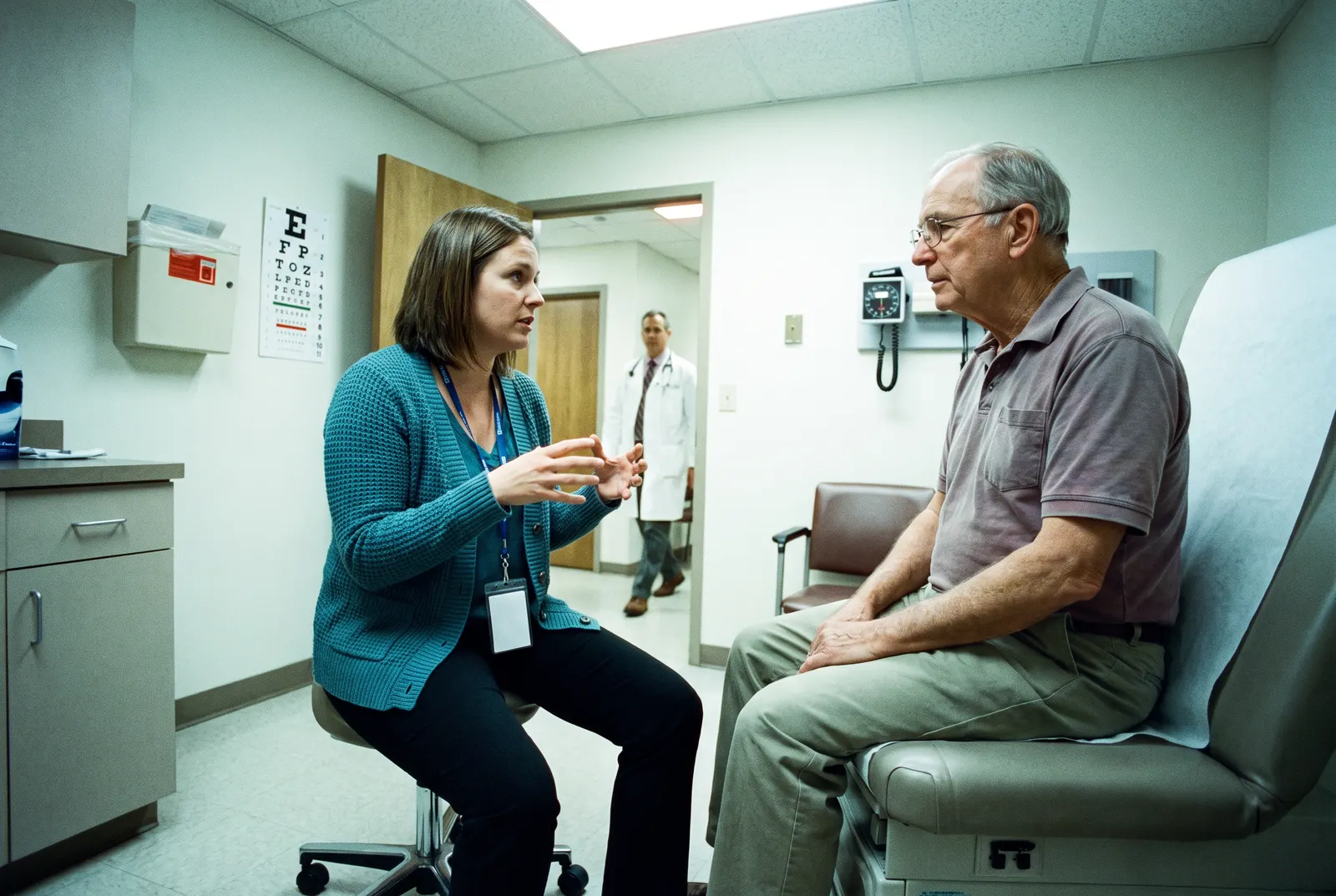
A behavioral health counselor is a clinician who assesses and treats mental health conditions, substance use disorders and problem behaviors, usually in a clinic, hospital, community agency or integrated primary care practice. It is an employer’s job title. No state issues a “behavioral health counselor” license, so the person in the role almost always holds a state professional counseling license (LPC, LMHC, LCPC, LPCC or LCMHC), an associate version of that license, or in some substance use jobs a state addiction counseling certification.
If you are searching the title because you saw it on a job board, that is the main thing to know. The title tells you about the setting and the population. The license tells you what you are allowed to do, and that license comes from a clinical mental health counseling master’s degree in most cases.
Why Do Employers Use the Title Behavioral Health Counselor?
“Behavioral health” became the standard umbrella in health care because it puts mental illness and substance use under one heading. Health systems, Medicaid managed care plans and federal agencies use it when they fund or bill for both kinds of care together. When a hospital or a federally qualified health center posts for a behavioral health counselor, it is usually hiring someone who can handle depression on Monday, an opioid use disorder intake on Tuesday and a teenager’s self-harm risk assessment on Wednesday.
The federal government handles this the same way. The BLS does not have a separate code for behavioral health counselors. It counts them inside SOC 21-1018, Substance Abuse, Behavioral Disorder, and Mental Health Counselors, a single occupation that combines all three. That is also the code this site uses for mental health counselor pay, which tells you how closely the jobs overlap.
Where the titles differ, it is usually a hint about the employer:
- A mental health counselor posting often comes from an outpatient therapy practice or a group practice.
- A substance use or addiction counselor posting usually comes from a treatment program and may accept a state addiction credential.
- A behavioral health counselor or behavioral health clinician posting tends to come from hospitals, primary care networks, crisis services and community behavioral health centers, where the client mix covers both.
By the Numbers
- $59,350 Mental Health Counselor Median Pay
- $28.53 Median Hourly Wage
- 491,930 Jobs Nationwide
Source: BLS OEWS, May 2025
Which License Sits Behind the Behavioral Health Counselor Title?
For clinical work that includes diagnosis and treatment planning, the license is a state professional counseling license. States name it differently, which is its own source of confusion.
| License Title | Full Name | Example States |
|---|---|---|
| LPC | Licensed Professional Counselor | Texas, Virginia, Colorado, Georgia, Pennsylvania |
| LMHC | Licensed Mental Health Counselor | Florida, New York, Massachusetts, Washington |
| LCPC | Licensed Clinical Professional Counselor | Illinois, Maryland, Maine, Kansas |
| LPCC | Licensed Professional Clinical Counselor | California, Ohio, Minnesota, Kentucky |
| LCMHC | Licensed Clinical Mental Health Counselor | North Carolina, New Hampshire, Vermont, Utah |
Most states use two tiers. A new graduate holds a provisional or associate license (names like LPC-A, LPCC-A, LMHC-Intern or LCMHCA) while logging 2,000 to 4,000 supervised post-master’s hours over two to three years. After that, the board grants the independent license. Many behavioral health employers hire at the associate tier and provide the supervision, which is one of the main reasons new graduates start in these settings.
The other route into the title runs through substance use certification. The BLS notes that substance abuse and behavioral disorder counselors typically need at least a bachelor’s degree, while mental health counselors typically need a master’s degree and an internship. A bachelor’s-level addiction counselor can hold a behavioral health job in some programs, but the scope is narrower and private practice is off the table. The BLS says substance abuse and behavioral disorder counselors in private practice must be licensed, and that all states require these counselors to have a master’s degree for that license. Our addiction counselor guide walks through both entry doors.
For a deeper look at how these titles compare state to state, see LMHC vs. LPC vs. LCPC vs. LPCC.
Where Do Behavioral Health Counselors Work?
The BLS breaks down the largest employers of SOC 21-1018 workers this way:
| Employer Type | Share of Jobs (2025) |
|---|---|
| Offices of other health practitioners | 20% |
| Outpatient mental health and substance abuse centers | 16% |
| Individual and family services | 15% |
| Residential mental health and substance abuse facilities | 8% |
| Educational services (state, local and private) | 7% |
Each of those settings shapes the job differently.
Community behavioral health centers and outpatient clinics carry the heaviest Medicaid caseloads. Expect high acuity, a mix of mental health and substance use diagnoses, productivity targets, and usually free supervision toward licensure. Many associates do their two or three years here.
Integrated primary care is the setting where “behavioral health” is most literal. The counselor sits inside a medical clinic and sees patients in short, focused visits the same day a physician flags a concern. Sessions run shorter than standard therapy hours, and the work leans on screening, brief intervention and coordination with the medical team.
Hospitals and crisis services include emergency department assessments, inpatient psychiatric units and mobile crisis teams. Shifts may include nights and weekends. Risk assessment and safety planning dominate.
Residential treatment covers both mental health and substance use facilities. The work is group heavy, with structured daily programming and family sessions.
Telehealth and group practices have grown, and these are where the independent license matters most, because insurers credential licensed clinicians.
What Does a Behavioral Health Counselor Do Each Day?
The BLS lists the core duties for this occupation: evaluating clients’ mental and physical health, addiction or problem behavior and readiness for treatment; developing treatment goals and plans with clients and families; helping clients build skills to recover or change behavior; documenting progress; teaching families about addiction or behavioral disorders; referring clients to other services; and planning discharge.
In a typical community clinic week, that turns into intakes and biopsychosocial assessments, individual sessions, one or two groups, treatment plan reviews, case consultation, and a lot of notes. Documentation is the piece new counselors underestimate. Every session note has to support medical necessity for the payer, and in a busy agency notes often run into the evening.
Co-occurring disorders are the norm. A client referred for anxiety may also be drinking heavily, and a client in a substance use program often has untreated depression or trauma. This is the practical reason employers prefer counselors trained for both. The 2024 CACREP Standards for clinical mental health counseling include diagnosis and treatment across mental, behavioral and neurodevelopmental disorders, and service delivery across the continuum of care, from primary care and outpatient to inpatient, integrated behavioral health care and aftercare. A CMHC degree is built for exactly this job description.
How Does Behavioral Health Counseling Relate to Mental Health and Substance Use Counseling?
Picture three overlapping circles. Mental health counseling covers mood, anxiety, trauma, relationship and adjustment problems, and serious mental illness. Substance use counseling covers alcohol and drug use disorders and behavioral addictions such as gambling. Behavioral health is the label for the space covering both.
In practice, the license draws the real lines:
| Licensed Clinical Counselor (LPC, LMHC, etc.) | State Certified Addiction Counselor | |
|---|---|---|
| Typical education | 60-credit master’s in counseling | Varies by state, often bachelor’s or less |
| Graduate clinical hours | 700, including 280 direct (CACREP) | Set by state certification board |
| Post-degree supervision | 2,000 to 4,000 hours | Set by state certification board |
| Exam | NCE or NCMHCE | State or national addiction exam |
| Treats mental health diagnoses | Yes, within scope | Generally limited to substance use |
| Private practice | Allowed once independently licensed | Requires a license with a master’s degree |
If you want the widest set of behavioral health jobs, the clinical license is the one that opens all of them. An addiction credential gets you into treatment programs faster, but you hit a ceiling on scope and pay. Some states also run a separate license for master’s-level addiction clinicians, so check your board.
The full career walkthrough for the clinical side is in our mental health counselor guide, and the license ladder is covered in the licensed professional counselor guide.
How Much Do Behavioral Health Counselors Make?
Using SOC 21-1018, the BLS reports these May 2025 national wages:
| Wage Measure | Annual |
|---|---|
| 10th percentile | $38,940 |
| 25th percentile | $47,100 |
| Median | $59,350 |
| Mean | $64,440 |
| 75th percentile | $76,530 |
| 90th percentile | $97,590 |
The hourly median is $28.53, across 491,930 jobs. Two cautions when reading this. First, the code mixes bachelor’s-level substance use counselors with independently licensed clinicians, which pulls the lower percentiles down. Second, OEWS excludes self-employed private practice counselors, so the top end of the field is missing.
State pay varies a lot. Alaska posts a $80,770 median, Oregon $74,590 and New Mexico $74,100, while Louisiana sits at $37,910 and Mississippi at $46,990. Those gaps reflect state Medicaid rates and licensure rules as much as cost of living. The full state table and the setting-by-setting comparison are in our mental health counselor salary guide, and the associate to independent jump is covered in LPC and LMHC salary.
In my reading of job postings and the wage data together, the largest single pay jump in this field comes from moving from the associate tier to the independent license, more than from changing employers. Getting through supervision without stalls is worth planning for.
Is a Behavioral Health Counselor the Same as a Behavioral Health Technician?
No, and job boards mix them up constantly. A behavioral health technician, sometimes called a mental health technician or behavioral health aide, works under clinical staff in hospitals and residential programs. Techs monitor safety on units, help run daily schedules, document observations and support groups. Many of those jobs ask for a high school diploma or a bachelor’s degree, and none of them include diagnosis or independent treatment planning.
The counselor role sits above the technician on the clinical team. If you see a posting with “behavioral health” in the title, read the requirements line. A posting that asks for an LPC, LMHC or associate license is a counseling job. One that asks for CPR, a diploma and shift availability is a technician job. Technician work can still be a smart first step for someone planning a master’s, since it shows you the setting from the inside.
Related Rankings
- Addiction Counseling CMHCClinical mental health counseling master's programs with addiction, substance abuse, or co-occurring disorder specializations.
- Best CMHC Master's ProgramsCompare accredited clinical mental health counseling master's programs ranked on cost, earnings, completion, CACREP status, and flexibility.
- CACREP-Accredited CMHC ProgramsCACREP-accredited clinical mental health counseling master's degrees meeting the 60-credit and 700-hour clinical standard, ranked by score.
- Online CMHC for Working AdultsFlexible online clinical mental health counseling master's degrees designed around full-time work schedules, evening sessions, and multiple starts.
What Is the Job Outlook for Behavioral Health Counselors?
The BLS projects employment in this occupation to grow 18% from 2025 to 2035, much faster than the average for all occupations, with about 50,500 openings a year. The Occupational Outlook Handbook counts about 533,400 jobs in 2025, a larger figure than the OEWS wage count because the two programs measure differently.
Many of those openings replace counselors who leave the occupation, so turnover drives hiring along with growth. In practice, demand is strongest for clinicians who are licensed (or close to it) and comfortable with co-occurring disorders.
Licensure portability also matters more than it used to. The Counseling Compact lets an independently licensed counselor in a live member state apply for a privilege to practice in other live member states. As of November 2026, 11 states are live and 41 jurisdictions have enacted it. That is especially useful for telehealth behavioral health jobs. Our Counseling Compact guide lists the states and the rules.
How Do You Become a Behavioral Health Counselor?
The licensed route looks like this:
- Finish a bachelor’s degree in any field. Psychology, social work and human services are common, but counseling programs admit other majors.
- Earn a 60-credit clinical mental health counseling master’s. CACREP sets that 60-semester-credit floor. Choose a program with an addiction or co-occurring emphasis if you want the substance use side covered in depth. Our addiction counseling master’s programs list collects those.
- Complete 700 supervised graduate clinical hours, including 280 direct client hours. Placing your internship at a behavioral health agency often leads straight to a job offer.
- Pass the NCE or NCMHCE, depending on your state, and apply for the associate license.
- Log 2,000 to 4,000 supervised hours over two to three years, then upgrade to the independent license.
Some programs we have reviewed build the substance use piece into the degree. Colorado Christian University lists a substance use disorders concentration, Thomas University an addictions counseling concentration, and University of Mary an addiction counseling option. For working adults who need evening or part-time pacing, see the online CMHC programs for working adults list, and for a broad starting point the best CMHC programs ranking.
What Skills Do Behavioral Health Employers Look For?
Job postings for this title are remarkably consistent once you read a few dozen. Beyond the license, employers want evidence that you can work in a fast, mixed setting.
Assessment under time pressure. Intake appointments in community clinics and primary care are short, and the counselor has to gather history, screen for risk, reach a working diagnosis and set a plan in one visit. Programs that give you many supervised intakes during internship prepare you better than ones that teach assessment only in a classroom.
Co-occurring treatment. Postings often ask for experience with both mental health and substance use, and some name specific approaches such as motivational interviewing or cognitive behavioral therapy. If your degree offers an addiction elective or concentration, take it.
Documentation that holds up. Agencies are audited by payers. A counselor who writes clear notes tying each session to the treatment plan is worth a lot to an employer, and supervisors notice it fast.
Crisis and safety planning. Most behavioral health settings see suicide risk regularly. Comfort with structured risk assessment, safety plans and hospital referral is close to a requirement.
Teamwork with medical staff. In integrated care and hospitals, you work alongside physicians, nurses, psychiatric prescribers and case managers. Explaining a behavioral concern in a sentence or two to a busy physician is a real skill.
What Should You Ask a Behavioral Health Employer Before Accepting?
Because the title covers so many settings, two jobs with the same name can be very different. A few questions sort them out quickly.
Ask whether the employer provides clinical supervision toward licensure, how often, and whether the supervisor is approved by your state board. Free, board-approved supervision is worth real money during the associate years.
Ask about productivity expectations. Agencies set a weekly number of billable hours, and the gap between a reasonable target and an unreasonable one decides whether you finish notes at work or at home.
Ask what the client mix looks like. Some behavioral health roles are mostly substance use, others mostly serious mental illness, others mostly primary care referrals for anxiety and depression. The mix tells you what training you will get.
Ask about loan repayment eligibility. Many community behavioral health employers qualify for public service or federal workforce repayment programs, which can offset the lower early pay.
Also ask how the employer handles the move to the independent license. Some raise pay automatically when you upgrade; others make you renegotiate.
Is Behavioral Health Counseling a Good Career?
It depends on what you want from the work. The pros are real: strong projected demand, a wide range of settings, and the chance to do meaningful work with people other systems have failed. Employers in community behavioral health often cover supervision, which is a genuine financial help during the associate years.
The tradeoffs are also real. Entry pay in community agencies sits near the lower percentiles, caseloads can be heavy, and documentation never ends. Crisis work brings secondary trauma. Counselors who last in this field usually set boundaries early, find a good supervisor, and move toward a setting that fits them once licensed.
If the title appeals because you want to treat both mental health and substance use, the most flexible move is a CACREP-accredited CMHC degree with co-occurring training. You can compare those on the CACREP-accredited CMHC programs list.
Mental Health Counselor Pay by State
In May 2025, the Bureau of Labor Statistics reported a median annual wage of $59,350 for mental health counselor nationwide, with the middle half earning between $47,100 and $76,530. About 491,930 people held these jobs.
Alaska had the highest published state median at $80,770, and Louisiana the lowest at $37,910. The table lists every state where BLS publishes a median for this occupation.
See the Wage Table for All 51 States
| State | Median | 10th Percentile | 90th Percentile | Jobs |
|---|---|---|---|---|
| Alaska | $80,770 | $58,240 | $114,650 | 1,290 |
| Oregon | $74,590 | $49,860 | $102,830 | 8,160 |
| New Mexico | $74,100 | $48,900 | $113,420 | 2,420 |
| Washington | $68,910 | $47,220 | $110,580 | 14,250 |
| North Dakota | $68,630 | $43,270 | $86,630 | 1,290 |
| Arizona | $65,300 | $44,520 | $95,210 | 9,990 |
| Rhode Island | $65,120 | $43,960 | $98,440 | 2,170 |
| Utah | $63,890 | $35,410 | $106,080 | 6,320 |
| Nebraska | $63,770 | $42,400 | $109,610 | 2,170 |
| Connecticut | $63,590 | $44,080 | $99,540 | 7,540 |
| Idaho | $63,360 | $36,400 | $98,760 | 2,990 |
| Wyoming | $62,980 | $36,960 | $103,150 | 910 |
| New Jersey | $62,820 | $40,630 | $104,310 | 14,210 |
| Texas | $62,630 | $37,650 | $95,910 | 21,400 |
| Colorado | $62,390 | $44,060 | $100,020 | 14,920 |
| Wisconsin | $62,220 | $46,510 | $94,640 | 8,340 |
| Vermont | $61,810 | $47,820 | $80,690 | 1,120 |
| Michigan | $61,690 | $38,490 | $94,400 | 10,100 |
| Iowa | $60,880 | $44,450 | $102,890 | 3,530 |
| Illinois | $60,730 | $43,010 | $109,100 | 20,250 |
| District of Columbia | $60,450 | $43,060 | $107,980 | 1,260 |
| Hawaii | $60,090 | $48,460 | $104,790 | 2,110 |
| Maine | $59,970 | $43,310 | $89,220 | 1,930 |
| Massachusetts | $59,890 | $43,180 | $96,200 | 18,190 |
| Virginia | $59,880 | $39,730 | $100,040 | 17,940 |
| Maryland | $59,530 | $44,050 | $91,980 | 9,730 |
| Kansas | $59,470 | $37,910 | $85,860 | 2,600 |
| New York | $59,450 | $42,410 | $90,590 | 26,770 |
| Oklahoma | $59,350 | $35,350 | $92,870 | 5,150 |
| California | $59,250 | $44,640 | $111,080 | 75,610 |
| Montana | $59,000 | $36,840 | $83,640 | 1,820 |
| Georgia | $58,960 | $37,390 | $90,980 | 9,600 |
| Minnesota | $58,780 | $45,250 | $77,320 | 7,110 |
| Ohio | $58,360 | $39,010 | $83,730 | 18,020 |
| Nevada | $57,210 | $42,920 | $98,010 | 1,810 |
| Missouri | $56,910 | $37,650 | $89,400 | 8,130 |
| Florida | $56,790 | $39,430 | $84,410 | 29,750 |
| Delaware | $56,020 | $36,940 | $80,710 | 1,700 |
| North Carolina | $55,490 | $37,440 | $86,010 | 10,300 |
| New Hampshire | $54,840 | $38,480 | $81,050 | 3,690 |
| Kentucky | $54,190 | $35,150 | $83,070 | 7,690 |
| Indiana | $53,760 | $37,580 | $83,200 | 11,890 |
| South Dakota | $53,650 | $39,210 | $67,010 | 1,710 |
| South Carolina | $52,370 | $35,010 | $81,420 | 6,300 |
| Pennsylvania | $52,010 | $36,280 | $81,970 | 30,620 |
| Arkansas | $51,580 | $35,760 | $100,270 | 2,570 |
| Tennessee | $49,580 | $34,950 | $76,620 | 9,040 |
| West Virginia | $49,430 | $36,990 | $73,360 | 2,100 |
| Alabama | $47,310 | $34,420 | $76,510 | |
| Mississippi | $46,990 | $32,770 | $77,310 | 2,090 |
| Louisiana | $37,910 | $29,860 | $65,720 | 6,420 |
Frequently Asked Questions
Is a Behavioral Health Counselor the Same as a Mental Health Counselor?
What License Does a Behavioral Health Counselor Need?
How Much Do Behavioral Health Counselors Make?
Can a Behavioral Health Counselor Diagnose?
Do You Need a Master's Degree to Be a Behavioral Health Counselor?
Keep Reading
 Mental Health CounselorWhat a mental health counselor does day to day, where they work, May 2025 BLS pay, and the 60-credit master's and license the job requires.
 Addiction CounselorLearn how to become an addiction counselor, comparing CADC certificates vs. CMHC master's degrees, dual licensure, treatment settings, and BLS pay.
 Licensed Professional CounselorLearn how to become a licensed professional counselor (LPC), from 60-credit CACREP training and NCE or NCMHCE exams to Counseling Compact portability.
 Mental Health Counselor SalaryMental health counselors earn a $59,350 national median in May 2025 BLS data. Compare state wage gaps and verified CMHC tuition ROI.
 LMHC vs. LPC vs. LPCCStates use LPC, LMHC, LCPC, LPCC, and LCMHC for independent counselors. Compare state titles, exams, Counseling Compact states, and BLS pay.
Sources
5 references
- Occupational Outlook Handbook: Substance Abuse, Behavioral Disorder, and Mental Health Counselors
- Occupational Employment and Wage Statistics, May 2025 (SOC 21-1018)
- 2024 CACREP Standards, Section 5.C Clinical Mental Health Counseling
- National Clinical Mental Health Counseling Examination
- Counseling Compact
All sources retrieved .